
Astronomers claim capturing birth of new Solar System
In a groundbreaking development in space science, astronomers have claimed capturing birth of a new Solar system
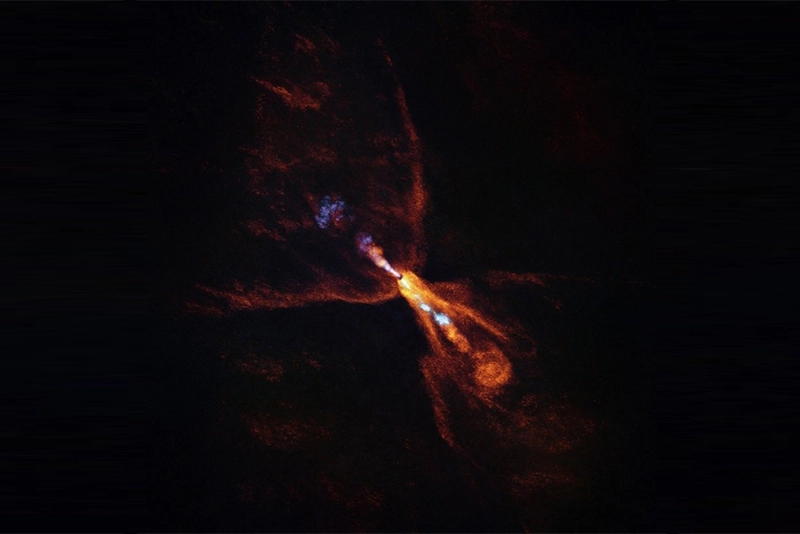
[The infant star HOPS-315 showing the first signs of planet formation. (Image credit: ALMA(ESO/NAOJ/NRAO)/M. McClure et al.)]
In a groundbreaking development in space science, astronomers have claimed capturing birth of a new Solar system.
The breakthrough was made possible with data from the Atacama Large Millimeter/ submillimeter Array (ALMA), an array of 66 radio telescopes located in the desert of northern Chile, and observations from the James Webb Space Telescope (JWST), according to Space.com.
"For the first time, we have identified the earliest moment when planet formation is initiated around a star other than our sun," team leader and Leiden University researcher Melissa McClure said.
The team's results were published on Wednesday July 16, 2025 in the journal Nature.
This team was able to spot traces of hot minerals condensing in the protoplanetary disk swirling around a baby start known as HOPS-315. HOPS-315, located 1,300 light-years away from us, resembles a younger version of the Earth's own Sun.
The discovery reveals the early stages of planetary development, where gases begin condensing into solid crystalline minerals that will ultimately grow into rocky planets.
Until now, researchers had only detected slightly larger dust grains forming in various systems. But in this case, they’ve observed the very start of solidification itself, making it the earliest phase of planet formation ever seen.
"Zero Moment"
Talking to EarthSky, lead researcher Melissa McClure of Leiden University in The Netherlands, said what they saw was never seen before.
"We were seeing time zero moment in the formation of another planetary system that's very similar to our own Sun but its located much further away in the constellation of Orion", she said.
Explaining more about protostar and protoplanets, Melissa said, “A protostar is a very hot ball of gas that has started to condense and it’s contracting that will eventually start to burn hydrogen and forms something that becomes star.”
Though this discovery is a monumental first, scientists caution that we won’t be watching entire planets emerge in real time. The formation process occurs over hundreds of thousands of years. Still, the team hopes to continue monitoring HOPS-315 while searching for other infant systems caught in this extraordinary early stage.
The discovery marks "the birth of the seeds of the planets," study co-author Edwin Bergin, a professor at the University of Michigan, told CBS News. The silicate-mineral rich material around HOPS-315 will make planets after another million years or so.
"So we are watching the beginnings of the construction of planets," Bergin said.
With the discovery, Bergin said researchers now know what to look for to find other budding systems.
Follow ummid.com WhatsApp Channel for all the latest updates.
Select Language To Read in Urdu, Hindi, Marathi or Arabic.

For all the latest News, Opinions and Views, download ummid.com App.

 Post Comments