4,500 yrs on, Makkah continues to lead by example in generosity, politeness
Not generosity alone, politeness and humbleness are also the hallmark of the Makkah residents. Read on as Aleem Faizee shares the first-hand account of what he witnessed and experienced during his Umrah visit
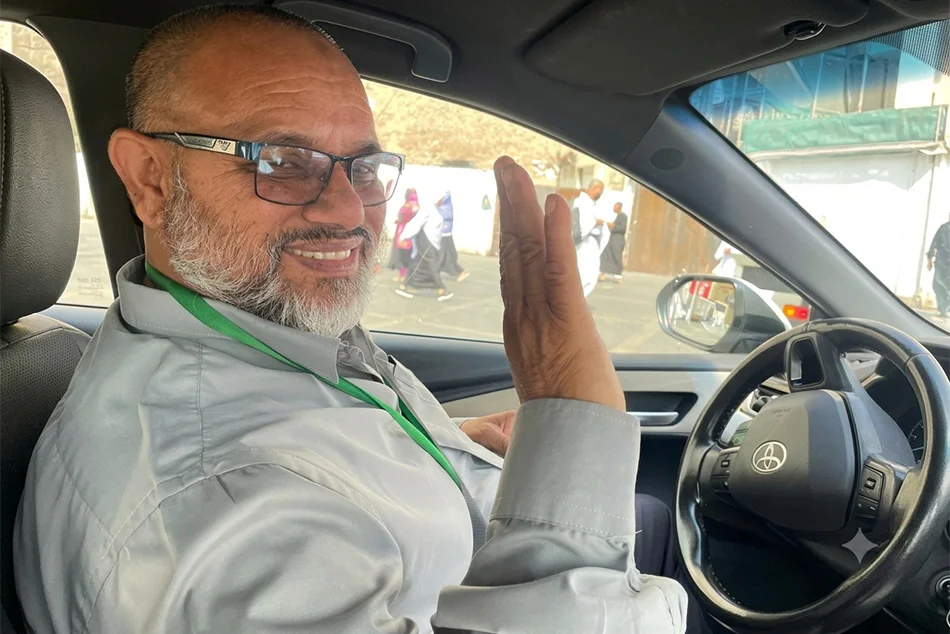
[Omar Farooque offers free ride to pilgrims on their way to The Grand Mosque whenever he is nearby and spots any. (Image: ummid.com)]
On September 29, 2026, hours after arriving in Makkah al Mukarramah, I, along with my wife, left the Hotel Dorrat al Akhyar on Ibrahim al Khalil Road in Misfalah area of the Holy City, and walked towards The Grand Mosque, Masjid e Haram, to perform Umrah.
It was 09:40 am and Makkah al Mukarramah was already sizzling at over 40 degrees. Under intense heat, we were exploring different travel means to reach the Makkah Grand Mosque. Suddenly, a taxi stopped by us.
“Come in… Come in and sit”, the man behind the wheel said.
Puzzled, I looked at my wife.
“Come in and sit… No fares… It’s free”, he repeated even before we could exchange a word.
The man behind the wheel was Omar Farooque – a Bangladeshi expatriate. He was living in Makkah for the past 20 years.
We boarded his limousine car and the first thing that caught our eyes was a “declaration” in Urdu and English.
“The ride is free if the meter is not downed”, it was written in bold letters.
Omar Farooque offers free ride to pilgrims on their way to The Grand Mosque whenever he is nearby and spots any.
“No. This is not on behalf of my company. As per the agreement, I have to make a fixed amount to my company. Beyond that it is up to me to charge or provide free ride to pilgrims”, Omar Farooque told ummid.com with a generous, and satisfying, smile in reply to a question.
A typical taxi fare from Dorrat al Akhyar to Masjid al Haram Makkah is 15 to 20 Saudi Riyal. For expatriates every riyal counts. Hence for someone like Omar Farooque sacrificing these riyals and providing free ride to pilgrims is not a small gesture.
However, what has encouraged Omar Farooque is his long stay in Makkah al Mukarramah – known for its generosity and services to pilgrims ever since it’s known history.
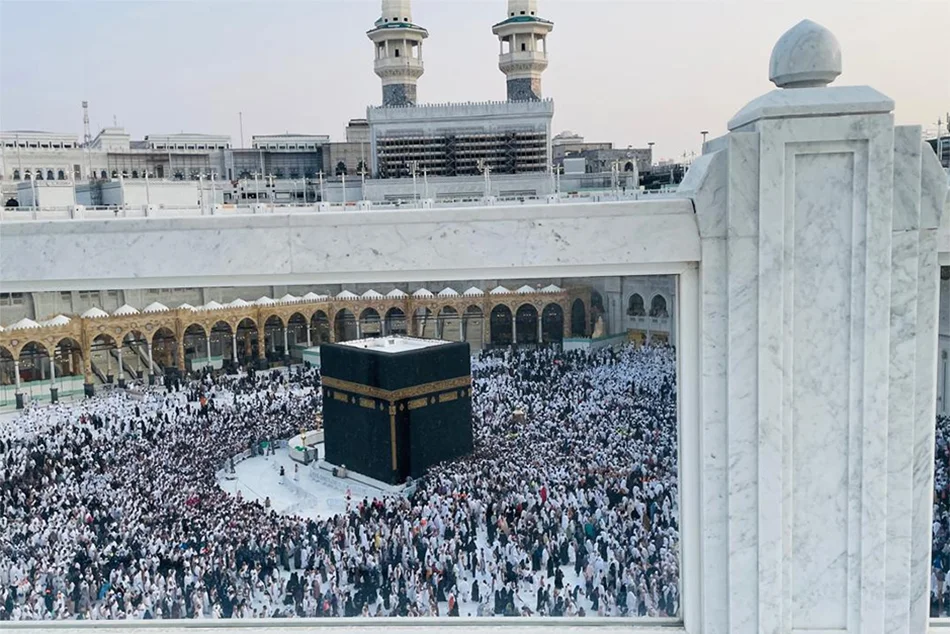
[The Holy Kaaba inside the Makkah Grand Mosque – the First House of Allah, The Almighty, was built by Prophet Adam (peace be upon him). {Image: ummid.com)]
Makkah al Mukarramah: A Brief History
The Holy Kaaba inside the Makkah Grand Mosque – the First House of Allah, The Almighty, was built by Prophet Adam (peace be upon him). The city was, however, damaged in the Noahic Flood, Muslim scholars believe based on Islamic sources.
Later, Prophet Ibrahim (Abraham) revived the Holy City after he left his wife Hagar (Hajar) and their son Prophet Ismail (Ishmael), an infant then. It was around 4,500 years from now, and this was the time when there was no trace of any life in the barren valley. During this testing time, Allah, The Almighty, gifted the mother and son duo the Zam Zam well.
As per the details provided by different Islamic scholars, when their water supply ran out, Hajar desperately ran seven times between the hills of Safa and Marwa to search for help or water. Returning to her crying infant, she saw Ismail scraping the ground with his heel (as per some sources Angel Jibreel struck the earth), causing a fresh water spring to gush forth. Hajar tried to contain the flowing water by saying "Zam, Zam" (meaning "stop, stop" or "fill, fill"), which gave the well its name.
The presence of the water attracted passing caravans, leading to the Jurhum tribe settling there and turning the valley into the City of Makkah al Mukarramah. Prophet Ibrahim and Prophet Ismael later re-built the Holy Kaaba exactly at its original location.
During the same period, Prophet Ibrahim received the divine indications to sacrifice Prophet Ismail. The Holy Quran describes the whole incident explaining how Prophet Ibrahim prepared to complete the sacrifice but Allah spared Ismail and replaced him with a large ram (sheep) from the paradise.
With time, the Zam Zam Well was damaged and lost, and it was rediscovered and re-dug by Abd al Muttalib, one of the leaders of the Quraysh tribe and the custodian of the Holy Kaaba and the grandfather of Prophet Muhammad (peace be upon him). The Zam Zam well was rediscovered long before the birth of Prophet Muhammad (peace be upon him).
The Pilgrimage to Makkah al Mukarramah is a commemoration of the sacrifices of Prophet Ibrahim, his wife Hagar and their noble son Prophet Ismail. Makkah and the Holy Kaaba remained in their original form after the death of Prophet Ibrahim and Prophet Ismail, and people from different parts of the world used to travel to Makkah for the pilgrimage – Hajj and Umrah, ever since.
While Hajj is one of the five pillars of Islam and is performed once in a year in the month of Dhul Hijjah, Umrah is lesser Hajj which can be performed any time and in any month.
Generosity of Makkah Residents
Qurayesh and Makkah residents from other tribes, known for their generosity, considered it their duty to serve the pilgrims. Historians have recorded how they will compete with each other, sometimes even fight, to feed the pilgrims and provide them comfort. This has been the case before and after the birth of Prophet Muhammad (peace be upon him).
The tradition continues till date, and the visitors to the Holy City can see local residents opening their coffers to provide food, especially water, and comfort to pilgrims. As pilgrims circumambulate the Holy Kaaba, they will find Makkah residents offering them high quality dates. While in Makkah, it is also a common scene to watch pilgrims lining outside restaurants near Haram for free biryani and juice packs paid by local donors.
In Islamic tradition, using pleasant scents like natural Oud and alcohol-free attar is considered a Sunnah (recommended practice) and a sign of personal hygiene and respect. Accordingly, local residents are also seen spraying perfumes of different scents on the pilgrims in the Grand Mosque and in the vicinity, and those circumambulating the Holy Kaaba.
Even though cans filled with cold Zam Zam water have been placed in every nooks and corners of the Grand Mosque and its courtyards, bottles with drinking water are made available in plenty so that the pilgrims do not face any problem because of the intense heat.
Before Asr prayers every day many local residents are seen coming to the Grand Mosque carrying the flasks and thermos bottles filled with coffee, tea and qehwa to offer to pilgrims.
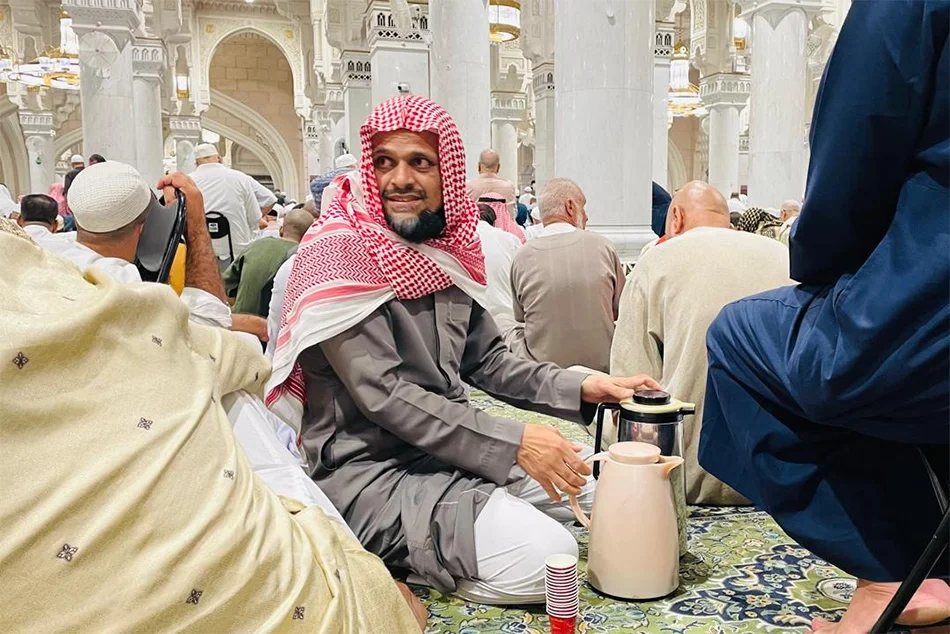
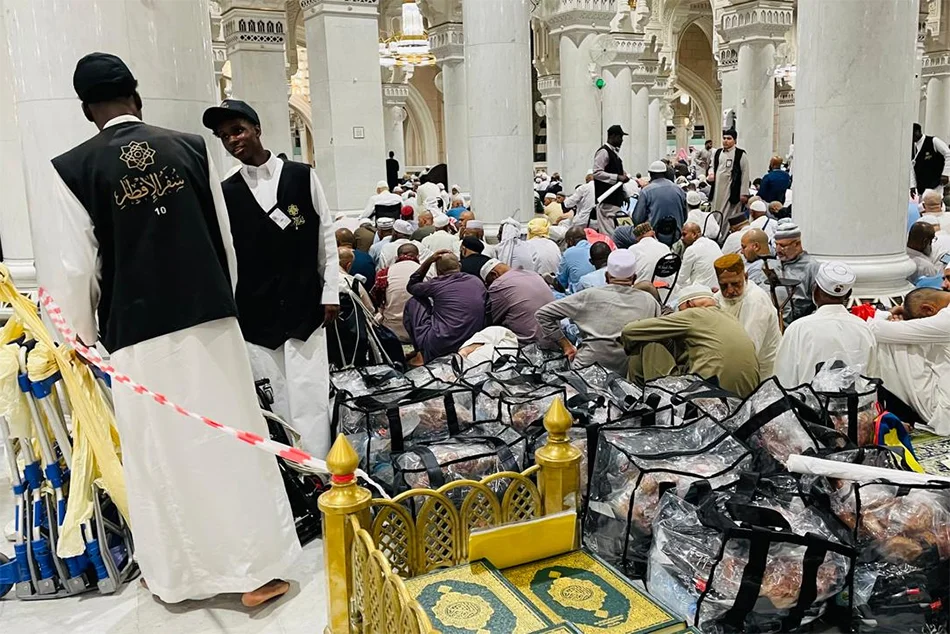
[Volunteers wearing “Sufarul Iftaar” jackets are seen serving the meal “Iftaar us Saem” kit to pilgrims – immaterial if you are fasting or not. (Image: ummid.com)]
When Generosity of Makkah Residents Reaches its Peak
The generosity of Makkah residents reaches its peak every Monday and Thursday, and on 13th, 14th and 15th of the Islamic months.
Prophet Mohammed (Peace be upon him) was used to fast every Monday and Thursday, and also on 13th, 14th and 15th of the month, called Ayyam-e-Baiz also spelled Ayyam al-Beed or the "white days".
These are voluntary and not obligatory fasts like the fasting in the Holy Month of Ramadan. But, as it was the practice of Prophet Muhammad (Peace be upon him) to fast on these days, Muslims follow him.
Vans after vans carrying special Iftar meal can be seen lined up in the Grand Mosque on these days. The sufra, a long communal dining spreads and plastic sheets are laid out across the Grand Mosque's halls, interior floors, and courtyards for fasting worshippers to break their fast. Volunteers wearing “Sufarul Iftaar” jackets are seen serving the meal “Iftaar us Saem” kit to pilgrims – immaterial if you are fasting or not. The same is seen in Masjd e Nabawi, The Prophet’s Mosque, in Madinah al Munawwarah.
The free availability of drinking water bottlers is not limited to The Grand Mosque in Makkah and Masjid e Nabawi in Madinah alone. When pilgrims visit Arafat, Mina, Muzdalefah, Hira and Sour Caves in Makkah or Mount Uhud, Badr, Masjid Qiblatain, Quba Mosque and other places of historic significance in Madinah al Munawwarah they will see free drinking water bottles at their perusal.
“I never have to pay for drinking water during my 20-day stay in Makkah and Madinah”, Irfan Ahmed, a pilgrim told ummid.com.
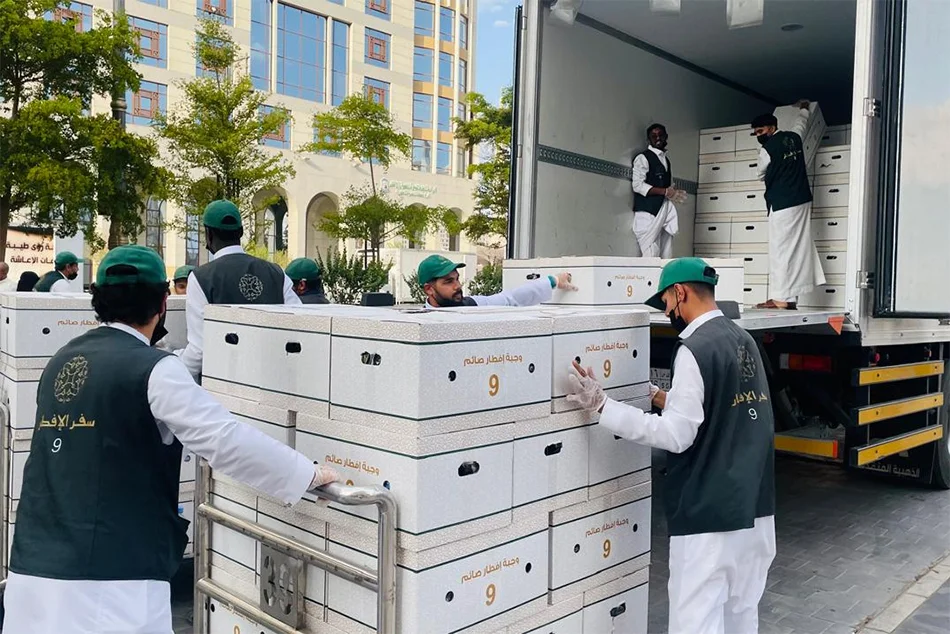
[Vans after vans carrying special Iftar meal can be seen lined up in the Grand Mosque on these days. (Image: ummid.com)]
Politeness is another Hall Mark of Makkah Residents
Not generosity alone, politeness and humbleness are also the hallmark of the Makkah residents. The capacity of the Grand Mosque in Makkah is around 4 million and the mosque is full to its capacity during Hajj and in Ramadan.
In other days, at least 2 million pilgrims are always present in the premises at any given time. In the presence of such a huge number of pilgrims chaotic scuffle, jostling, pushing and shoving should be a norm.
But, not in Makkah al Mukarramah!!!
Extending greetings and exchanging Salaam alaikum, local residents will welcome the pilgrims. No arguments with anyone. On the slightest indication of any dispute, they will step back, throw a smile, hug and offer perfume to mend ways.
Combined with these individual efforts, the Saudi Government in itself spends millions of dollars for the relief and comfort of the pilgrims.
Hundreds of washrooms, with special provision for ablution, have been built so that the pilgrims face no difficulty. Housekeeping, maintenance, and help and support staff are available round the clock to keep The Grand Mosque and its surroundings neat and clean.
“Extraordinary and exemplary… It appears there is one staffer for every pilgrim to pick litters and keep everything neat and clean”, my wife said.
[The writer, Aleem Faizee, is Founder Editor of ummid.com. Aleem Faizee has also worked as a Researcher at Tata Institute of Social Sciences (TISS) and with Action Aid for its research work published as “BROKEN PROMISES -A study on the socio-economic status of Indian Muslims: Seven years post Sachar”. His research work “Mollywood: The Rise and Fall of a Subaltern Cinema” is part of the book “Creative Industries in India” published by Routledge India of Taylor and Francis Group, London. A prolific writer, Aleem Faizee has also written for The Times of India as a Freelance Journalist for over 10 years.]
Follow ummid.com WhatsApp Channel for all the latest updates.
Select Language to Translate in Urdu, Hindi, Marathi or Arabic