Tarluvada IT Hub: India’s AI Boom is Being Built on Dalit Dreams
Until Google renamed it 'Tarluvada IT Hub and Data Centre Hub' on Google Maps, the Tarluvada village outside Visakhapatnam was known for marigolds, roses and jasmine, grown alongside cashew and teak.
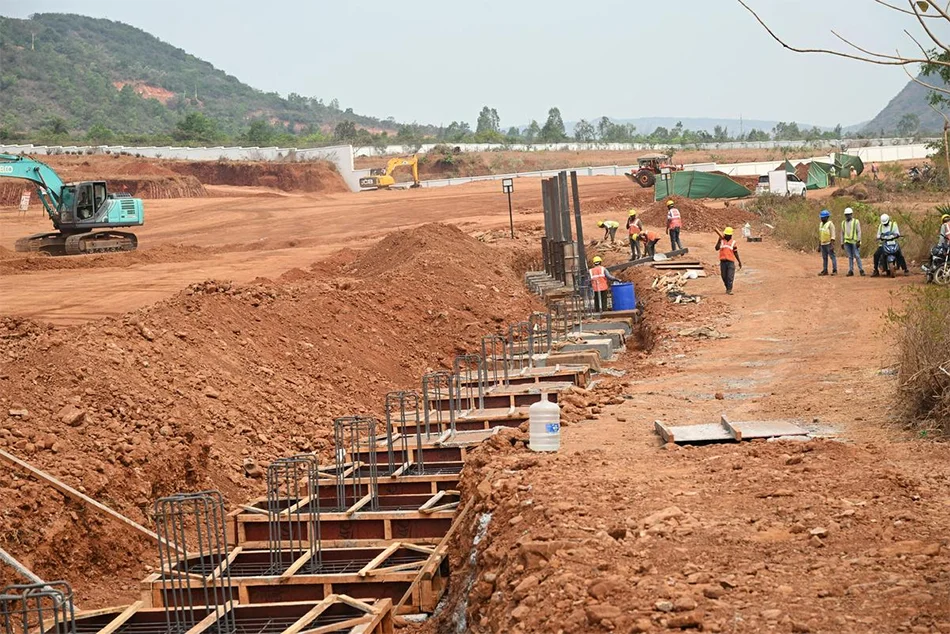
Until Google renamed it “Tarluvada IT Hub and Data Centre Hub” on Google Maps, this village outside Visakhapatnam was known for marigolds, roses and jasmine, grown alongside cashew and teak.
Pyla Kondamma, who is a farmer and former head of the village council, held a land here under a state-issued D-patta title — the kind of assigned land the government gave to landless Dalit families as a one-time correction for historic dispossession. Talking to journalists, she said she will never give up the land - neither to the Andhra Pradesh government nor to Google. Her neighbour Relli Ramakrishna has not made the daily walk to the farm where she once grew cashews, mangoes and seasonal vegetables. The land is gone, and what replaces it is still unclear.
Lands for Tarluvada IT Hub
The state has approved about 601 acres across three sites for the project — Tarluvada, the principal hub, at 266.6 acres; Adavivaram and Mudasarlova at 160 acres; and Rambilli at 175 acres — for what is being promoted as Asia’s largest data-centre campus, a 1-gigawatt hub whose filed power requirement is about 2.1 GW, led by Google and built with the Adani Group and Airtel Nxtra.
Google has promised $15 billion over five years, its largest investment outside the United States, and officials have projected the project could support up to 188,000 jobs. Land acquisition for the Tarluvada portion was declared complete in February 2026: 308 acres acquired, of which 266.6 acres have been formally handed over. These figures suggest technological progress. But investment alone cannot measure development. It must be weighed against the lives of the people whose land makes it possible.
In the 1970s, Andhra Pradesh distributed roughly two acres per household to landless Dalit families, and this was done under the state land-reform law. A 1977 Act barred the transfer of this assigned land, specifically to keep it outside the market. Independent trackers — Land Conflict Watch and the outlet BehanBox, among them — report that a portion of the Tarluvada acquisition is such D-patta land, though their published estimates of the exact acreage differ, and neither could be independently confirmed here.
Land Conflict Watch puts D-patta and unrecorded lands together at about 204 acres, while another report counts roughly 110 acres of D-patta land within the 308 acres and what is consistent here across accounts is the underlying fact — land meant as a corrective for historic landlessness is now flowing into an industrial park. For a Dalit family, that land meant food, seasonal income, space for livestock, a form of social security and a possible inheritance — and a degree of independence in a society that has long pushed Dalit families toward insecure labour.
Actual Cost and Compensation
Compensation was initially fixed at ₹17 lakh per acre for D-patta land. Later it was raised to ₹20 lakh after farmers pushed back — with reported payouts running at two-and-a-half times that rate, which is close to ₹50 lakh per acre, though some villagers say it was later cut to ₹40 lakh in exchange for 20 cents of land per acre, and officials say 51 assignees gave written consent during the acquisition. But a cheque compensates for land as property. It does not automatically replace the social and economic life built around it.
A flower vendor’s livelihood depends not only on a field but on cultivation, seasonal labour, local buyers and inherited knowledge. A contract job is not equivalent to owning a productive resource. A shop may generate income, but only if the family has the skills, capital and sustained demand to run it. Once the land disappears, the network that sustained the livelihood can disappear with it — and a hyperscale data centre, once built, mainly needs electricity, cooling systems, engineers and specialised technical staff, not the labour of the families who gave up their fields. The Human Rights Forum, citing company-submitted documents, says the three sites would together create only 1,725 permanent jobs, against ₹23,000 crore in subsidies.
The issue of consent is more difficult. The authorities have cited the written agreement of 51 assignees and the revised compensation as proof that the process was voluntary. Furthermore, in April 2026 the opposition CPI (M) held a protest claiming that the party leaders who had gone to meet the Tarluvada farmers were detained. As reported by The Wire and BehanBox, the Dalit families, including the women who led the resistance, were subjected to continuous pressure to sell. It can only be said that a consent is meaningful when people have full information, enough time and the real ability to refuse, not just when a meeting takes place after a project has already been approved.
The Human Rights Forum has likewise described the land-pooling and acquisition process as opaque and lacking meaningful community consultation, and the space for scrutiny has narrowed further whereas in September 2026, Meta restricted the Instagram account of the citizen campaign “Stop Vizag Data Centers,” after nine of its posts had already been restricted.
Environmental Costs
The project also carries environmental costs that compound the land question. Land Conflict Watch has flagged a contradiction between the project’s statutory filings and the state’s own expert appraisal committee over how much of the Tarluvada site overlaps with reserve forest land — a dispute that remains unresolved in the public record. The Adavivaram–Mudasarlova site is also very close to the Kambalakonda Wildlife Sanctuary, a home to leopards and pangolins, and a public-interest petition before the Andhra Pradesh High Court has reportedly questioned construction noise and clearances; petitioners have also reportedly challenged the use of roughly 160 acres of Simhachalam temple land, which the state says was leased, not transferred. Visakhapatnam already draws some 410 million litres of water a day against a requirement of about 480 million, according to figures the state government itself has cited, and the Human Rights Forum notes that groundwater depletion and erratic rainfall have already put the city under acute water stress.
Google has told Reuters the project will follow applicable law and use advanced air cooling to protect local water resources. Adani did not respond to queries put to it. The state government has reportedly dismissed activists’ concerns as inaccurate and misleading while saying it remains open to feedback, and has offered the project a discount of Re 1 per unit on electricity for fifteen years. The Andhra Pradesh High Court has, according to reports, so far declined to halt construction but has asked the government to confirm that the necessary legal and environmental clearances are in place; the case is still being heard.
The issue is not whether Andhra Pradesh should welcome technology, but whether this specific model of technological development perpetuates caste inequality because a project cannot claim to be inclusive when Dalit families lose their very own land that was assigned to them precisely to address historical landlessness, and while the project’s environmental clearances are contested, its consent process is disputed, and its promised jobs remain, for now, a projection rather than a record.
The inhabitants of Tarluvada should receive more than just compensation once the decisions have been taken. This entails having an independent and publicly released social-impact audit; full disclosure of the MoUs, the environmental assessments and the records relating to compensation; rehabilitation that is linked to people’s means of livelihood rather than merely to cash; and the settlement of the ongoing High Court case before any further construction takes place.
India can build an AI economy without viewing marginalised groups as something that can be discarded. For, if it is necessary for Dalit farmers to give up both their land and their means of livelihood to secure an uncertain future, then that is not inclusive development; it is just the old inequality between land and labour, now expressed in the language of technology.
[The writer, Potnuru Yasaswini, is a fourth-year English Honours student in the Department of English and Cultural Studies at CHRIST (Deemed to be University). Passionate about research, she has presented her work at national and international conferences and has published research in both English studies and psychology.]
Follow ummid.com WhatsApp Channel for all the latest updates.
Select Language to Translate in Urdu, Hindi, Marathi or Arabic