AMU Students on Strike Demanding Restoration of Union
Seven years without an elected students union has left the Aligarh Muslim Univesrity (AMU) students without formal representation, and the protest is now demanding an end to this situation.
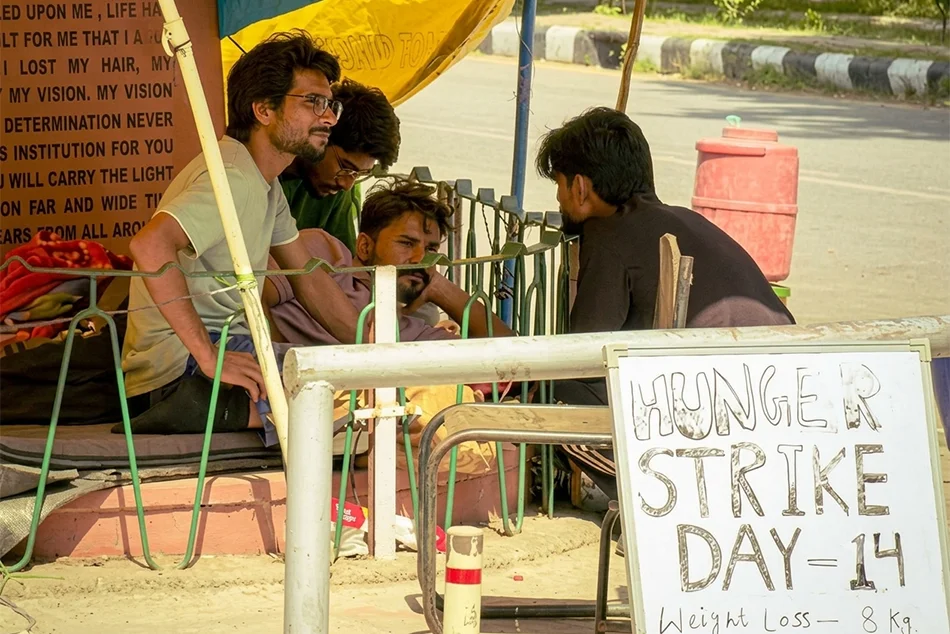
For the last 14 days, a protest has been underway at Aligarh Muslim University (AMU) demanding the restoration of the AMU Students Union (AMUSU) election which have not been conducted for nearly seven years.
As the second week of the protest draws to a close, student Yasir Fahad remains on an indefinite hunger strike. Despite the seriousness of the situation, there has been no constructive dialogue or discussion initiated by the university administration.
A protest does not emerge in a single day. There are reasons behind every mobilisation, and in this case, those reasons are evident.
How the Protest Began
The current agitation began after female students of Abdullah Hall and Women’s College at AMU protested against the poor quality of food being served to them. The students alleged that insects were being found in their meals.
The protest led to wider criticism and compelled the administration to respond. The students allege that they were manhandled during the response.
Even before the women’s protest, students in a boys’ hostel had raised similar concerns about food quality. Their complaints had prompted the administration to have dinner with the students as an assurance that the quality of food would be improved.
Following the women’s protest, Yasir Fahad, accompanied by a group of students, approached the university administration and submitted a memorandum demanding the conduct of the students union elections and the release of the election notification within 48 hours. The students warned that failure to do so would lead to a protest on campus.
In response, the AMU administration suspended Yasir Fahad without issuing any show-cause notice, alleging his involvement in the Women’s College protest, his opposition to the administration, participation in what it called an “illegal protest” and blocking a road, allegedly causing inconvenience to others.
In response to the suspension, Yasir Fahad began a hunger strike. Fourteen days later, he remains on strike, while students say that no constructive dialogue has taken place between the administration and the protesting students.
A Growing Student Movement
The protest has continued to grow. The Students’ Federation of India (SFI), AMU unit, has extended its support, with its members participating actively at the protest site.
Several MPs and MLAs have also expressed solidarity with the protesting students, giving the agitation wider recognition. Former student representatives have participated as well, demonstrating their support for the students and their demand for representation.
The protest site has also become a space for student creativity and political expression. Graffiti, posters of Sir Syed Ahmad Khan and a portrait of Che Guevara can be seen together.
Both figures are associated, in different ways, with ideas of transformation and social change, making their presence at the protest site significant for a new generation of students.
The slogans raised at the protest are reminiscent of those heard at demonstrations at Jantar Mantar. The students have therefore begun referring to their protest site, Duck Point, as a “Mini Jantar Mantar” within the AMU campus.
Allegations of Disruption
As the protest entered its second week, students alleged that some prominent social-media personalities who became active at the protest site created chaos and confrontation.
The students further alleged that these individuals had been brought in to create disturbances in the protest and claimed that they were acting at the behest of the university administration. On the day of their visit, a major confrontation reportedly took place, following which FIRs were registered.
The university administration, however, has described the FIRs as being against “illegal students” and alleged that some of those involved were criminal elements.
The competing claims have added another layer of tension to an already escalating confrontation between the students and the administration.
The Question of Democratic Representation
At the heart of the ongoing protest is the demand for the restoration of the AMU Students Union.
For nearly seven years, students have had no formal elected representation through a student union. Students argue that a functioning union could provide an institutional mechanism for raising issues concerning student welfare, campus facilities and their rights.
The absence of such representation has become particularly significant in the context of the current agitation.
Recently, the Centre for Promotion of Educational and Cultural Advancement of Muslims of India (CEPECAMI) organised a programme at which AMU Vice Chancellor Naima Khatoon addressed students. She emphasised the socio-political and economic upliftment of students and the positive utilisation of university resources to contribute to the nation’s growth.
However, at a distance of around 150–200 metres from the programme, a student was sitting on hunger strike, reportedly experiencing pain and cramps, while demanding the restoration of democratic rights.
The contrast has drawn criticism from students and supporters of the agitation.
The director of CEPECAMI and professor in the Department of Political Science, Prof. Mohammad Mohibul Haque, has also faced criticism from students who argue that his public emphasis on political and social empowerment should be reflected in support for students seeking democratic representation. He had previously been perceived as supportive of the students’ cause.
Support From Students
Blind students of AMU have also expressed their support for the protest.
Students continue to emphasise that the restoration of the student union is necessary to address their concerns and provide them with a formal channel of representation.
The protest has therefore moved beyond the immediate questions surrounding food quality and the suspension of one student. It has developed into a broader demand for democratic representation within the university.
Seven years without an elected students union has left the AMU students without formal representation, and the protest is now demanding an end to this situation.
The university administration should come forward and ensure that the democratic process is restored on campus. A functioning student union would allow student leadership to emerge through an electoral process—the very kind of leadership and democratic participation that the Vice Chancellor herself has advocated from the university’s podium.
Farhan Siddiqui is an independent researcher with a postgraduate degree in Human Rights. His research interests include indigenous rights, environmental justice, tribal governance, constitutional law, and sustainable development. He is actively engaged in human rights research, advocacy, and socio-legal studies.
[The writer, Farhan Siddiqui, is Independent Researcher with a postgraduate degree in Human Rights. His research interests include indigenous rights, environmental justice, tribal governance, constitutional law, and sustainable development. He is actively engaged in human rights research, advocacy, and socio-legal studies.]
Follow ummid.com WhatsApp Channel for all the latest updates.
Select Language to Translate in Urdu, Hindi, Marathi or Arabic