What Lies for Muslims under Seemanchal as Union Territory
A closer examination suggests that the proposed Seemanchal Union Territory, comprising of the Seemanchal region of Bihar and part of West Bengal, is primarily a political project
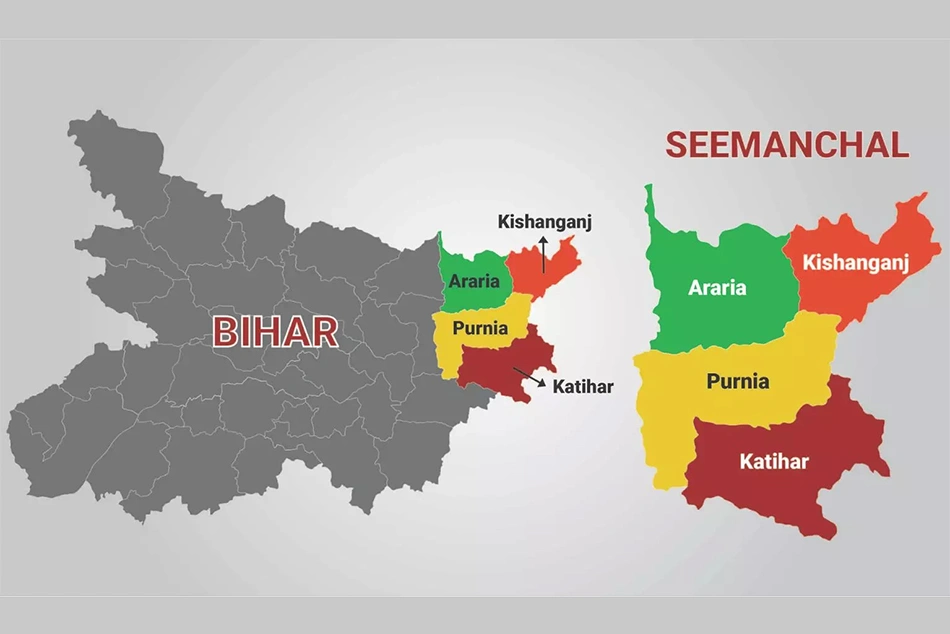
[Seemanchal’s importance for Muslims can be understood through a metaphor: It is often compared to Malta, highlighting its unique, isolated, and distinct demographic and political identity within a larger state. (Graphics: The Federal)]
Seemanchal is not just a border region, it is a mirror reflecting India’s development priorities and democratic promises. The Narendra Modi–Amit Shah combine’s apparent push to turn the region into a Union Territory (UT) raises serious concerns. It is certainly not driven by a commitment to empower the people — particularly the dominant Muslim population, nor does it merely reflect their stated determination to “remove every infiltrator from Indian soil.”
There is more here than meets the eye.
Only three days ago, while launching a high-stakes security and political outreach in the sensitive Seemanchal region ahead of the West Bengal Assembly elections, Amit Shah declared:
“Freedom from infiltrators doesn’t just mean removing their names from the voter list. We are determined to implement a program to remove every single infiltrator from the Indian soil. The Modi government is determined to free the entire country from infiltrators, and this initiative will soon begin in the entire Seemanchal region.”
Seemanchal: An Overview
Seemanchal’s importance for Muslims can be understood through a metaphor: It is often compared to Malta, highlighting its unique, isolated, and distinct demographic and political identity within a larger state. Like Malta’s distinctiveness within Europe, Seemanchal represents a concentrated population cluster (primarily Muslim-Yadav), a borderland geography, and a region with disproportionate influence on electoral outcomes—akin to a swing state.
Comprising the districts of Araria, Purnia, Kishanganj, and Katihar, Seemanchal has a high concentration of Muslim populations — approximately 40–70% in certain districts, setting it apart from the rest of Bihar.
Seemanchal is also a border region with deep socio-economic challenges, functioning as a distinct political and social entity. However, unlike Malta, whose Islamic past is largely historical, Seemanchal’s demographic reality is contemporary and politically consequential.
The region acts as a significant electoral bloc where Muslims, Yadavs, and other groups collectively shape outcomes. Despite its political importance, Seemanchal remains severely underdeveloped. A 2024 survey found that more than half of Muslim respondents felt unsafe, while opinions were divided on whether state authorities treated them unfairly. Interestingly, many Muslim voters indicated that a candidate’s religion is not their primary voting criterion.
Also Read: Snapshot of Muslims in Seemanchal
The proposed UT is also said to include parts of West Bengal — particularly Malda and North Dinajpur, both of which hold significant political weight due to their demographic composition. Malda, where Muslims form a majority in several constituencies, has historically been a major center of Muslim cultural and political life, dating back to medieval Bengal.
Politically, Malda has long been a Congress stronghold but has increasingly become a battleground between the Trinamool Congress (TMC) and the BJP. The Muslim electorate here tends to adopt a pragmatic approach: while sympathetic to Muslim representation, voters recognize that elected leaders often follow party lines rather than community interests.
The debate over creating a new UT comprising Seemanchal and parts of West Bengal has intensified ahead of the 2026 Bengal Assembly elections. The narrative is being driven largely by concerns over illegal immigration, national security, and demographic change. “Throw out illegal migrants” has emerged as a central campaign theme, with the Modi–Shah leadership presenting itself as determined to address infiltration in these regions.
In a past Independence Day address, Prime Minister Narendra Modi announced a “high-powered demography mission” to identify infiltrators, stating:
“No country can hand itself over to infiltrators.”
However, he did not clearly define the nature of the threat. Critics argue that such rhetoric is often directed at Bangla-speaking Muslims in Bihar, West Bengal, and Assam, where similar campaigns have been pursued.
A Political Project
It is important to distinguish between a Union Territory and a demography commission. A UT is an administrative unit governed directly by the central government, often created for strategic, political, or administrative reasons. A demography commission, on the other hand, studies population patterns, migration, and socioeconomic changes. Conflating the two obscures the real intent behind policy proposals.
A closer examination suggests that the proposed UT is primarily a political project. If administrative efficiency were the goal, detailed surveys and development initiatives would have preceded such a move. Historically, UTs have been created for governance efficiency or to preserve distinct cultural identities—conditions that do not clearly apply here.
Moreover, the regions proposed for inclusion lack cultural and social homogeneity. Differences in language, food habits, and social practices between Seemanchal and districts like Malda are significant. The only commonality appears to be the presence of large Muslim populations — leading critics to argue that the move is driven by identity politics rather than administrative logic.
Historically, migration between Bihar, Bengal, and what is now Bangladesh, has been complex and multi-directional, shaped by Partition, economic hardship, and communal violence. Simplifying this history into a narrative of “infiltration” ignores these realities.
Today, Seemanchal’s Muslim population faces acute poverty. According to NITI Aayog’s Multidimensional Poverty Index (2023), these districts rank among the poorest in Bihar. Surveys show high levels of economic backwardness, poor housing conditions, and low educational attainment. Yet, instead of sustained development interventions, political mobilization around identity and security dominates the discourse.
The Modi–Shah strategy appears aimed at polarizing voters in Bihar and West Bengal, particularly ahead of upcoming elections. By foregrounding issues of infiltration and demographic change, the ruling establishment may be seeking to consolidate support among Hindu voters.
At the same time, fear and insecurity among Muslims are being politically mobilized by parties like AIMIM, which has made electoral gains in the region. Traditional parties such as the RJD and Congress continue to retain influence, but the political landscape is increasingly fragmented.
Ultimately, Seemanchal stands at the intersection of poverty, identity, and electoral strategy. The question remains whether it will be treated as a region in need of development and inclusion — or as a laboratory for divisive politics.
[The writer, Arun Srivastava, is a Senior Journalist]
Follow ummid.com WhatsApp Channel for all the latest updates.
Select Language to Translate in Urdu, Hindi, Marathi or Arabic