US-Saudi Nuclear Deal: Redrawing Middle East's Atomic Map
The latest US-Saudi Arabia nuclear agreement, formalised under Section 123 of the US Atomic Energy Act, gives American firms legal access to build out Saudi Arabia's civilian nuclear programme, alongside separate bilateral safeguards accord signed by Energy Secretary Chris Wright and Saudi Energy Minister Prince Abdulaziz bin Salman.
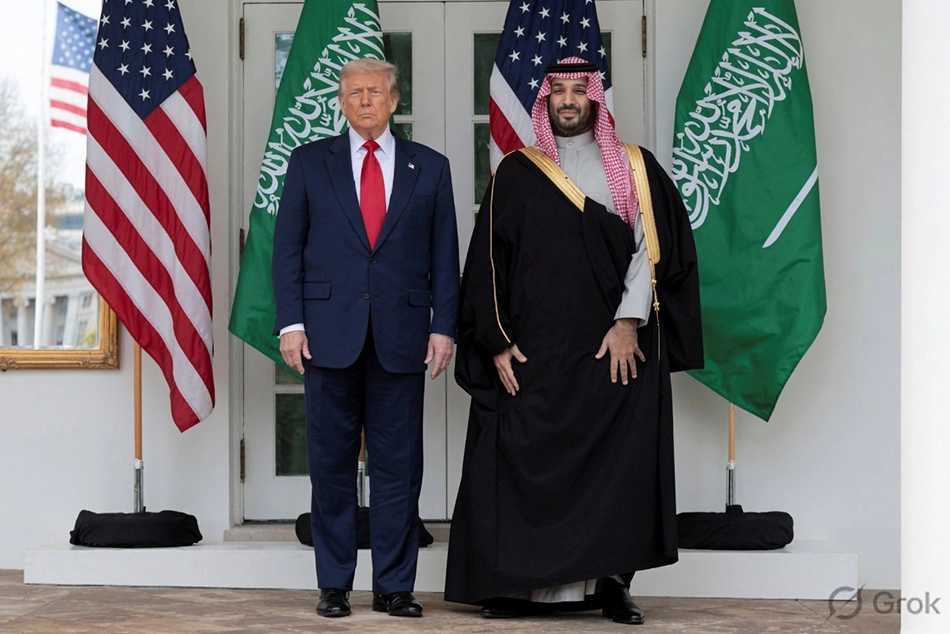
[Saudi Crown Prince and Prime Minister, Mohammad bin Salman, and US President Donald Trump (File Image)]
Washington and Riyadh have signed a civilian nuclear cooperation pact that could let Saudi Arabia enrich uranium on its own soil. Announced this week, and now headed to the US Congress, the deal marks a historic shift in US non-proliferation policy, alarms Israel and threatens to reshape the regional balance of power just as the US and Iran remain locked in confrontation.
The latest US-Saudi Arabia nuclear agreement, formalised under Section 123 of the US Atomic Energy Act, gives American firms legal access to build out Saudi Arabia's civilian nuclear programme, alongside separate bilateral safeguards accord signed by Energy Secretary Chris Wright and Saudi Energy Minister Prince Abdulaziz bin Salman.
The Department of Energy framed the agreement as a "decades-long, multi-billion-dollar partnership" that would create American jobs while strengthening ties with the Kingdom.
Details emerging since the signing indicates the pact runs for roughly 30 years and, crucially, does not commit Riyadh to the so-called "gold standard" - the industry term for a blanket ban on uranium enrichment and spent-fuel reprocessing that the UAE accepted when it built its Barakah plant.
Instead, the two countries are expected to conduct a two-year study on whether an enrichment facility on Saudi territory would be commercially viable, rather than having Riyadh permanently rely on imported, US-supervised fuel.
US Administration officials insist the deal still upholds "the highest standards of nuclear safety and nonproliferation," and note it does not itself hand over fuel-cycle technology - only a legal pathway for future cooperation. The US Congress now has a mandatory review window, reportedly around 90 days, during which lawmakers could try to block the pact, though doing so would require a two-thirds majority in both chambers - a high bar that makes rejection unlikely absent broad bipartisan revolt.
Why Riyadh Wants The Nuclear Deal?
Saudi Arabia is the world's largest oil exporter, yet burns huge volumes of crude and natural gas domestically for power and desalination plants- more than a million barrels a day at peak summer months, by some estimates.
Nuclear power, under Crown Prince Mohammed bin Salman's Vision 2030 diversification plan, would free up that oil for export while cutting emissions. But energy economics is only part of the story. The crown prince has repeatedly said that if Iran ever builds a nuclear weapon, Saudi Arabia will match it, a declaration meant to pressure Tehran but one that has also deepened suspicion about Riyadh's own long-term intentions.
Enrichment capability - even framed as civilian - gives the kingdom a technical foundation it did not previously have, along with negotiating leverage over Washington and a hedge against Iran and, increasingly, against uncertainty about US security guarantees generally.
A Region Already on Edge
The timing amplifies the stakes. The deal comes as the United States continues strikes against Iran aimed at forcing it to abandon its own nuclear ambitions, and lawmakers including Senator Chris Murphy warning publicly that rewarding Saudi Arabia with enrichment rights while bombing Iran removes any incentive for Tehran to curb its programme.
Non-proliferation specialists go further: Henry Sokolski of the Nonproliferation Policy Education Center has argued that wherever Saudi Arabia goes, the UAE, Turkey and Egypt are likely to follow, seeking equivalent arrangements rather than accept second-tier status.
Compounding the picture, Saudi Arabia signed a mutual defence pact with nuclear-armed Pakistan last year, after which Pakistan's defence minister said its nuclear programme would be "made available" to Riyadh if needed - a statement widely read as a signal aimed at Israel.
Analysts at the Carnegie Endowment and elsewhere describe the cumulative effect as eroding, rather than reinforcing, the non-proliferation architecture the US has spent decades building in the Gulf.
Israel's Alarm
Israel, long assumed to be the region's only nuclear-armed state, has reacted with unusual public anxiety, even though the Netanyahu government has stayed largely silent through official channels.
Opposition figures have been blunt. Former prime minister Naftali Bennett called the emerging pact a "serious strategic failure" negotiated over Israel's head, warning that enrichment on Saudi soil could produce a regional nuclear race and a dangerous loss of control.
Former defence ministers Benny Gantz and Avigdor Liberman echoed the warning, with Liberman predicting the civilian programme would eventually end in weapons capability and a frantic regional scramble. Israeli security officials, speaking privately, are reportedly worried less about Saudi intentions specifically than about setting a precedent: Once Riyadh secures enrichment rights, it becomes far harder to deny the same to Ankara, Cairo or Abu Dhabi.
There is also a deeper strategic loss for Israel. Civilian nuclear cooperation was originally conceived, under the Biden administration, as an inducement to help broker Saudi-Israeli normalisation as part of a broader regional "grand bargain." That leverage has effectively evaporated - Riyadh now appears set to receive the nuclear benefits without delivering normalisation in return, removing one of the few remaining incentives for a Saudi-Israeli thaw.
A Break From Precedent
For Washington, the deal represents a genuine reversal of policy that it has held, with some exceptions, since the 1970s: sensitive fuel-cycle technology is not extended to new states, particularly in volatile regions, without ironclad restrictions.
Non-proliferation experts have not minced words. Carnegie's James Acton has called the pact "tantamount to the United States giving up on non-proliferation," while congressional Democrats, including Representative Gregory Meeks and Senator Edward Markey, argue it erodes standards the US itself insisted on elsewhere, including with the UAE.
The administration's counterargument is that tight US involvement - potentially including a "black box" arrangement where American personnel control any enrichment facility - will prevent diversion, and that walking away simply cedes the contract, and the influence that comes with it, to Russia, China or France.
Whether that safeguard holds is precisely the unresolved question Congress must now weigh: some non-proliferation analysts warn Saudi Arabia could, in theory, nationalise a jointly built facility years down the line, forcing a future US administration into an impossible choice between accepting a fait accompli or confronting an ally militarily.
The Bottom Line
The US-Saudi nuclear pact is less a single transaction than a hinge point. It hands Riyadh a technical capability, financial partnership and geopolitical heft it has sought for years; it strips away a key normalisation incentive that once tied Saudi and Israeli interests together; and it signals to the rest of the region - and to Iran - that Washington's non-proliferation red lines are negotiable.
With Congress unlikely to muster the votes to block it, the more consequential fight may not be in Washington at all, but in how Israel, Iran, UAE, Turkey and Egypt each recalibrate their own nuclear calculus in response.
[The writer, Asad Mirza, is New Delhi based Journalist and Author.]
Follow ummid.com WhatsApp Channel for all the latest updates.
Select Language to Translate in Urdu, Hindi, Marathi or Arabic