Fact-Finding Report: Communal Tension Surrounding Bakra Eid in Mira Road
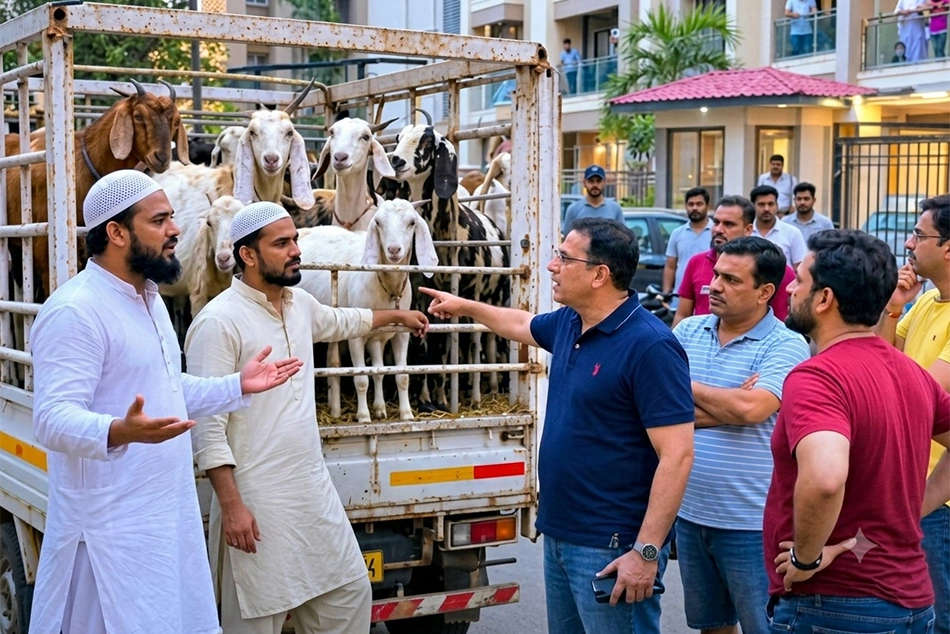
In May 2026, communal tensions arose at Poonam Estate Cluster 1, a large residential complex in Mira Road under the jurisdiction of the Mira-Bhayandar Municipal Corporation (MBMC), over the temporary keeping of goats ahead of Bakra Eid (Eid al Adha). Read The Fact Finding Report
Background and Fact Finding Process
In May 2026, communal tensions arose at Poonam Estate Cluster 1, a large residential complex in Mira Road under the jurisdiction of the Mira-Bhayandar Municipal Corporation (MBMC), over the temporary keeping of goats ahead of Bakra Eid (Eid al Adha).
What began as a dispute concerning a temporary goat enclosure escalated between approximately 22 and 26 May, involving objections from residents, municipal and police intervention, mobilisation of persons from outside the society, violence, involvement of religious and political organisations, and extensive circulation of competing narratives through social and conventional media. The episode significantly damaged relations within a residential community that residents from different faiths had described as historically cosmopolitan.
CSSS began its fact-finding on 30 May. The fact-finding team included Irfan Engineer, Director of CSSS; Sameer Wagle, member of civil society initiative Mumbai for Peace; Rukmini Iyer, peacebuilder; and Sudhakar Suradkar, retired IPS officer. The process included visits to Poonam Cluster; interviews with residents, managing committee representatives, political and community representatives and a person who reported being assaulted; an interview with Nagnath Kamble, associated with the Vishwa Hindu Parishad (VHP) and Bajrang Dal; engagement with senior municipal and police authorities; and observation of police-convened meetings with Muslim residents on 5 July and Hindu residents on 12 July.
CSSS met MBMC Municipal Commissioner Radhabinod A. Sharma, IAS, briefly on 2 July, but did not receive substantive clarification concerning the permissions process or the legal basis for municipal action. Deputy Commissioner of Police Rahul Laxman Chavan, IPS, directed the team to Senior Police Inspector Rajendra Kamble of Kashimira Police Station, who had handled the incident on the ground and subsequently engaged with CSSS.
This report distinguishes corroborated information and official statements from allegations and contested interpretations. Several relevant documents, including FIRs, CCTV footage, some permissions and correspondence, and municipal orders or circulars, were not available to CSSS. Conclusions concerning individual criminal responsibility are therefore outside the scope of this report.
The Immediate Dispute and Chronology
Poonam Cluster has a history of collective religious celebrations including Holi, Ganapati, Eid and Muharram. Muslim residents stated that goats had been temporarily kept within the society before Bakri Eid for approximately eight to ten years. They consistently maintained that qurbani, or ritual slaughter, had never taken place within the residential complex and was not intended there in 2026.
There had nevertheless been objections to the goat enclosure for several years. Hemendra Joshi, a Hindu resident who identified himself as a complainant, stated that he had raised objections from 2019 onwards, principally concerning smell and the use of common space. The 2026 conflict therefore involved a longstanding practice that was also subject to longstanding objections.
A police intimation or application was reportedly made around 13-15 May 2026, and Senior PI Kamble subsequently confirmed that police permission had been given on time. Preparation of the temporary enclosure reportedly began around 16 May. The society is also reported to have approached the fire department and MBMC, although the precise documentary trail remains incomplete. Residents stated that an application submitted to MBMC was acknowledged but neither approved nor rejected.
On or around 24 May, MBMC officials removed the asbestos roof of the temporary enclosure, reportedly on fire-safety grounds. The bamboo supports were subsequently removed. The authorities ultimately directed that the goats themselves be removed. Approximately 48 goats were transported on 26 May to a ground near NH School in Naya Nagar, with residents cooperating in their removal.
Senior PI Kamble subsequently stated that many goats lacked medical certificates, ear tags, photographs and other documentation that he said was required, and referred to animal-welfare and transportation requirements. He also maintained that a housing society managing committee could not itself legally authorise the storage of animals.
Residents, however, maintained that they had followed substantially the same practice for years, were willing to comply with applicable rules, and had not been informed of changed or newly enforced requirements despite approaching the authorities. Significantly, Senior PI Kamble stated that after the incident he had recommended that MBMC develop clearer regulations concerning the transportation and management of animals and related arrangements.
Escalation and Communalisation
The evidence indicates that genuine practical grievances existed concerning smell, hygiene, common space, visitors and society decision-making. These grievances were embedded within a longer deterioration of relations involving disputes over Taraweeh prayers, namaz, loudspeakers, religious lighting and banners, visitors attending religious events, festival committees and the use of common areas.
The conflict changed character when persons and organisations from outside the society became involved. Residents reported the arrival of persons associated with organisations including the VHP and Bajrang Dal. Nagnath Kamble stated that Poonam Cluster residents had approached the VHP for assistance and estimated that the crowd during the disturbances eventually reached 400-500 persons, including organisational members and other citizens.
Physical violence occurred during the disturbances. One person interviewed by CSSS, Rahim, reported being assaulted by a group after stopping near Poonam Cluster to enquire about the gathering. Police personnel reportedly extracted him from the crowd. Other assaults were also alleged. Senior PI Kamble stated that three FIRs had been registered in connection with the episode, while other testimony referred to additional accused persons and incidents. CSSS did not have sufficient documentary evidence to determine individual criminal responsibility.
The appearance of a pig during an already communally charged confrontation became a particularly provocative feature of the episode. Video footage circulated widely. The identity and intention of the person or persons responsible, and the precise circumstances of the incident, could not be conclusively established during the fact-finding.
Political intervention and social media further amplified the controversy. Public narratives increasingly framed the dispute in terms of animal sacrifice within a residential society. This was materially different from the account consistently given to CSSS that goats were being temporarily housed but qurbani was neither practised nor proposed within Poonam Cluster. The conflation of temporary housing, transportation and slaughter contributed to communalising what had initially included practical and regulatory disagreements.
Legal and Administrative Analysis
The legal issues surrounding the incident require several distinct questions to be separated: transportation of goats; temporary keeping of goats; animal welfare; slaughter; municipal regulation; fire and sanitation requirements; and the use of common residential spaces.
The Prevention of Cruelty to Animals Act, 1960[1], particularly Sections 3 and 11, establishes duties concerning animal welfare and prevention of unnecessary suffering. The Transport of Animals Rules, 1978[2], as amended, regulate the transportation of sheep and goats, including veterinary certification, fitness for transport, overcrowding and transport conditions. These provisions are relevant to the transportation and welfare of the animals but do not, by themselves, establish a blanket prohibition on temporarily keeping goats within residential society premises.
The Maharashtra Municipal Corporations Act, 1949[3] gives municipal corporations powers and responsibilities relating to public health, sanitation, markets, slaughterhouses and prevention of cruelty to animals, and enables municipal regulation through statutory powers, bye-laws and administrative measures. CSSS was, however, unable to establish which specific MBMC provision, bye-law or administrative order was relied upon to prohibit or regulate the temporary keeping of goats at Poonam Cluster in May 2026.
The Bombay High Court's interim order of 6 August 2019 in Jiv Maitri Trust v. Union of India[4] and Others concerned temporary permissions for slaughter during Bakri Eid and restrained permission for slaughter inside individual residential flats. Its subject matter was slaughter, and it does not on its face establish a general prohibition on temporarily keeping goats within residential society premises.
The Maharashtra Animal Preservation Act, 1976[5], as amended, prohibits or regulates the slaughter of specified cattle. Goats are not among the cattle categories whose slaughter is prohibited under the Act, although their slaughter remains subject to other applicable municipal, public-health, animal-welfare and location requirements.
CSSS therefore did not identify a legal provision that, by itself, establishes a blanket prohibition on temporarily keeping goats in every residential society in Maharashtra. This does not establish that the arrangements at Poonam Cluster were lawful: fire safety, sanitation, animal welfare, transportation documentation, municipal rules, cooperative housing requirements and common-space regulations may all apply.
The critical administrative issue is that neither the applicable requirements nor the legal basis for MBMC's intervention were made sufficiently clear to the affected residents or subsequently to CSSS. If requirements had changed or existing requirements were being enforced differently in 2026, they should have been communicated in advance and applied transparently and consistently.
Principal Findings
CSSS finds that the immediate controversy concerned the temporary keeping of goats rather than qurbani within Poonam Cluster. Public conflation of these distinct activities contributed to escalation.
The practice of temporarily keeping goats was longstanding, but objections to it also dated back at least to 2019. Genuine practical grievances concerning smell, hygiene, visitors, common space and internal decision-making therefore existed and should not be dismissed as inherently communal.
The regulatory environment was unclear. Different legal questions concerning transportation, animal welfare, temporary housing and slaughter were repeatedly conflated, while MBMC did not provide a clear account of the provisions relied upon in its intervention.
The involvement of outside religious, political and vigilante actors materially transformed an internal residential dispute into a wider communal confrontation. Whatever the merits of residents' grievances, outside organisations should neither exercise an extra-legal veto over residents' religious practices nor substitute themselves for lawful authorities and internal dispute-resolution mechanisms.
The incident also exposed a deeper deterioration in trust within Poonam Cluster. Muslim residents subsequently considered suspending public festival celebrations temporarily, while Hindu residents strongly opposed such a measure, particularly in relation to Ganesh Chaturthi. This disagreement could itself become a future flashpoint unless addressed through an inclusive and lawful process.
At the same time, residents from both communities expressed a desire for peaceful coexistence, clearer rules and dialogue. The police-convened engagement following the incident represents a constructive beginning, although dialogue cannot substitute for transparent administration, impartial investigation and consistent enforcement of law.
Recommendations
1. Clear and Uniform Regulations
MBMC and the police should publish accessible, multilingual guidance well before major festivals, clearly distinguishing requirements relating to transportation and temporary housing of animals, slaughter, sound, common spaces, sanitation, fire safety and crowd management. Rules should not be introduced or newly enforced at the last moment without reasonable notice.
2. Single-window Permissions
MBMC should establish a single-window system or nodal officer coordinating municipal, police, fire, veterinary, transport and other permissions. Comparable administrative facilitation should be available across religious communities.
3. Impartial Enforcement
Authorities should apply laws consistently and proportionately, provide written reasons for approvals and refusals, and avoid selective enforcement. Religious organisers should comply with applicable law in both letter and spirit.
4. Responsible Use of Common Spaces
Religious activities should take account of sanitation, smell, sound, access, safety, animal welfare and the rights of other residents. Housing societies should establish reasonable arrangements through inclusive processes rather than allowing either longstanding custom or unilateral objections to determine outcomes.
5. Inclusive Internal Mechanisms
Poonam Cluster should establish or strengthen a representative festival and welfare mechanism involving different faith communities, owners and tenants, women and senior citizens, with transparent procedures for advance planning and grievance resolution.
6. Dialogue Before Escalation
Practical disputes should first be addressed through direct, time-bound local dialogue, supported where appropriate by trained mediators or Mohalla/Shanti Committees. Unresolved legal questions should then be referred promptly to competent authorities.
7. Prevent External and Vigilante Interference
Police should act preventively against unauthorised gatherings, intimidation, threats, blockades and attempts by outside groups to impose decisions upon residential communities. Private organisations should not be treated as representatives of entire religious communities.
8. Address Hate Speech and Misinformation
Sections 196 and 299 of the Bharatiya Nyaya Sanhita, 2023[6] provide relevant offences concerning promoting enmity and deliberate acts intended to outrage religious feelings. The Supreme Court, in Shaheen Abdullah v. Union of India and Others[7], has directed police to take suo motu action where hate speech meeting the legal threshold comes to their notice. Political status or organisational affiliation should not insulate unlawful conduct from scrutiny.
Authorities, political actors, community organisations and the media should also communicate disputes accurately. In the present case, conflating temporary keeping of goats with slaughter significantly distorted public understanding.
9. Sustained peacebuilding
Mira-Bhayandar requires continuing inter-community engagement through credible Mohalla or Peace Committees, women's and youth dialogues, joint civic initiatives and rapid-response mechanisms capable of intervening before local disagreements become communal confrontations.
10. Address Municipal Infrastructure
MBMC should clarify and fulfil its responsibilities concerning lawful animal markets, slaughterhouse infrastructure, burial grounds and other facilities required by a religiously diverse urban population. Longstanding administrative deficits can create recurring logistical, public-health and communal tensions.
Conclusion
The Poonam Cluster incident was neither simply a dispute about goats nor an inexplicable outbreak of communal hostility. It arose through the interaction of longstanding religious practice, genuine local grievances, unclear regulation, weak internal dispute resolution, municipal action, outside mobilisation, political intervention, violence and social-media amplification.
The central lesson extends beyond Bakra Eid or Eid al Adha. Everyday differences in diverse urban communities will inevitably arise around religious practice, shared space, sound, sanitation and public facilities. When rules are clear, authorities act consistently and communities possess credible mechanisms for dialogue, such differences can remain practical disagreements. When administrative ambiguity, political mobilisation, misinformation and vigilante intervention enter the situation, ordinary disputes can rapidly acquire communal meaning.
Preventing recurrence therefore requires both sound administration and sustained social engagement: transparent and equal application of law, clear permissions, timely grievance resolution, protection from intimidation, responsible political and media conduct, and dialogue that respects religious difference while protecting shared civic space.
Legal and public sources consulted:
- The Prevention of Cruelty to Animals Act, 1960, especially sections 3 and 11. India Code, Government of India.
- The Transport of Animals Rules, 1978, as amended, including provisions governing transport of sheep and goats. Animal Welfare Board of India.
- The Maharashtra Municipal Corporations Act, 1949. India Code, Government of India.
- Jiv Maitri Trust v. Union of India and Others, Bombay High Court, interim order dated 6 August 2019.
- The Maharashtra Animal Preservation Act, 1976, as amended.
- The Bharatiya Nyaya Sanhita, 2023, sections 196 and 299. India Code, Government of India.
- Shaheen Abdullah v. Union of India and Others, Supreme Court of India, orders directing police authorities to register cases Suo motu where hate speech meeting the legal threshold comes to their notice.
[1] The Prevention of Cruelty to Animals Act, 1960, especially sections 3 and 11. India Code, Government of India.
[2] The Transport of Animals Rules, 1978, as amended, including provisions governing transport of sheep and goats. Animal Welfare Board of India.
[3] The Maharashtra Municipal Corporations Act, 1949. India Code, Government of India.
[4] Jiv Maitri Trust v. Union of India and Others, Bombay High Court, interim order dated 6 August 2019.
[5] The Maharashtra Animal Preservation Act, 1976, as amended.
[6] The Bharatiya Nyaya Sanhita, 2023, sections 196 and 299. India Code, Government of India.
[7] Shaheen Abdullah v. Union of India and Others, Supreme Court of India, orders directing police authorities to register cases suo motu where hate speech meeting the legal threshold comes to their notice.
[The above Fact Finding Report on the Communal Tensions Surrounding Bakri Eid at Poonam Estate Cluster 1, Mira Road, Maharashtra, May 2026 is prepared by Centre for Study of Society and Secularism (CSSS) based on fact-finding undertaken between 30 May and 12 July 2026.]
Follow ummid.com WhatsApp Channel for all the latest updates.
Select Language to Translate in Urdu, Hindi, Marathi or Arabic