Tolstoy, Golden Age, and Moral Foundations of Peace and Disarmament
Tolstoy’s relevance today lies in his insistence that peace begins with conscience, statistics may measure destruction, and treaties may regulate weapons, but only culture can nurture the belief that human life is sacred
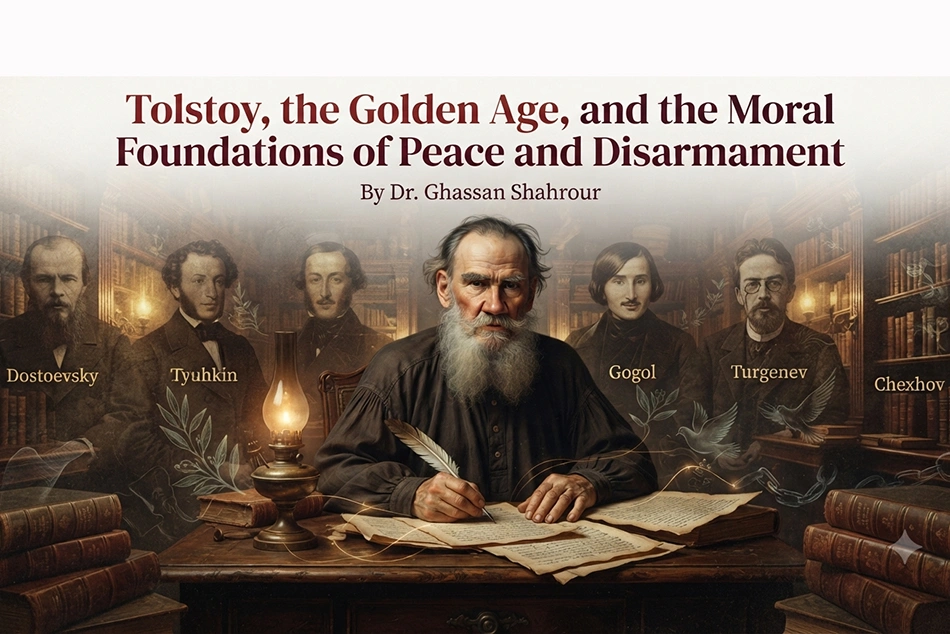
In the 19th century, when European powers repeatedly reshaped borders through war and states measured their strength by armies and conquests, Russia witnessed a remarkable literary flourishing known as the Golden Age of Russian Literature.
This cultural moment was not only artistic. It became a moral space in which writers explored human dignity, authority, justice, violence, suffering, and the meaning of life. Seen from today’s perspective, these works can be read as early contributions to questions that would later become central to the culture of peace and disarmament.
At the center of this moral landscape stands Leo Tolstoy, who shifted the question of war from the battlefield and political power into the realm of human conscience. His work offers questions that remain relevant in an age of nuclear weapons, autonomous systems, drones, and artificial intelligence in warfare.
Russian Literature and the Human Foundations of Peace
The writers of the Golden Age did not speak about disarmament in the modern sense. It would be historically inaccurate to impose twentieth-century concepts on them. Yet their works addressed human questions that later became essential to thinking about peace.
Pushkin explored freedom, dignity, and the individual in relation to authority. Gogol exposed the dehumanizing effects of bureaucracy when institutions stop seeing people as individuals. Turgenev examined social change and conflicts between generations. Dostoevsky explored the psychological roots of violence, resentment, pride, and revenge. Chekhov revealed the fragility of ordinary life and the human need for security, meaning, and justice.
These writers should not be turned retrospectively into disarmament advocates. Their importance lies in something deeper: they illuminate how peace begins with the value placed on human beings, and how cultures of violence are formed not only on battlefields but also through ideas, narratives, and moral assumptions that precede them.
Tolstoy: When War Becomes a Moral Question
With Tolstoy, this moral dimension reached exceptional intensity.
In War and Peace, war is not presented simply as battles, victories, and defeats. It becomes a test of human beings and of the belief that military power can give states meaningful control over history. Tolstoy pays attention not only to generals and armies but also to soldiers, families, civilians, fear, loss, and the disruption of ordinary life. He shifts the center of attention from the victorious state to the human being who bears the cost of war.
This shift matters for a culture of disarmament. Once the human being becomes the measure by which war is judged, the central question is no longer simply: Who won?
It becomes: What did the war do to human dignity, human life, relationships, and society?
One of Tolstoy’s enduring lessons is that military power may produce a battlefield outcome, but it cannot by itself provide moral legitimacy.
Challenging Violence and State Power
Tolstoy’s later writings, especially The Kingdom of God Is Within You, made his position even clearer. He increasingly rejected violence, criticized war and capital punishment, and challenged the state’s demand that individuals participate in killing.
For Tolstoy, nonviolence was not merely a tactic. It was an ethical stance rooted in the refusal to make killing acceptable simply because it is carried out in the name of the state, law, duty, or national interest.
This insight connects directly with modern debates about weapons. Weapons depend not only on technology and political decisions but also on social acceptance of organized violence. Changing a culture that glorifies force can therefore become part of the long road toward limiting violence and reducing the role of weapons in human affairs.
Tolstoy’s ideas had a significant influence on Gandhi’s understanding of nonviolence and contributed to moral traditions that later informed peace and disarmament movements.
Tolstoy and Modern Weapons: A Moral Intersection
The 20th and 21st centuries introduced weapons capable of destruction far beyond anything Tolstoy could have imagined. Nuclear weapons created the possibility of annihilating entire populations. Chemical and biological weapons expanded the scale of suffering. Today, autonomous systems, drones, and artificial intelligence are reshaping warfare by increasing speed, distance, and the possibility of killing without direct human presence.
Tolstoy did not write about these technologies. Yet some of his moral questions intersect with the dilemmas they create.
Does everything a state can do through force become morally legitimate?
Does possessing the capacity to destroy guarantee security?
What happens to human dignity when killing becomes automated, remote, or algorithmic?
Tolstoy’s contribution is not technical. It is moral. He helps keep alive the question of what violence does to human beings, and whether societies can remain just when military power becomes an end in itself.
Literature as Part of a Culture of Disarmament
Reading Russian literature through the lens of peace and disarmament does not mean turning its writers into modern activists. It means recognizing that political change also requires a cultural and moral foundation.
Treaties, laws, institutions, and verification mechanisms are essential to disarmament. But they operate within societies shaped by beliefs about security, power, violence, and the value of human life.
Literature can influence that moral landscape by expanding empathy, questioning authority, exposing the human consequences of violence, and making visible the suffering behind political abstractions.
In this sense, the Golden Age of Russian literature can be understood as an early space for exploring the moral conditions of peace. Tolstoy stands at its center because he brought together concerns about human dignity, the limits of power, the rejection of violence, and the value of human life.
Conclusion: From Literature to Human Responsibility
Tolstoy’s relevance today lies in his insistence that peace begins with conscience. Statistics may measure destruction, and treaties may regulate weapons, but only culture can nurture the belief that human life is sacred. The seed of disarmament is planted when societies refuse to glorify violence and choose instead to honor the dignity of every person. Across generations, this becomes a collective responsibility: to resist the normalization of killing, to protect human life, and to build a world where peace and disarmament are not only political objectives but expressions of our deepest human values.
[Dr. Ghassan Shahrour, Coordinator of the Arab Human Security Network, is a medical doctor, prolific author, and human rights advocate specializing in health, disability, culture, humanitarian disarmament, and human security. He has contributed to global campaigns for peace, disarmament, and the rights of persons with disabilities. The above article on is part of the author's ongoing work to deepen the culture of humanitarian disarmament and to strengthen the moral foundations of peace. Through Tolstoy, the Russian Golden Age, Mark Twain, Emir AbdulKadir, Goethe, and other enduring moral voices, I explore how literature and ethical thought can reinforce our commitment to human dignity, conscience, prevention, and limits on violence, especially for new generations.]
Follow ummid.com WhatsApp Channel for all the latest updates.
Select Language to Translate in Urdu, Hindi, Marathi or Arabic