Who Owns Mandate: Question as MPs, MLAs Switching Sides Becomes a Norm
The 111 cases should not be viewed merely as a list of politicians who switched from one party to another. They point towards a larger question: who ultimately owns an electoral mandate - the individual representative, the political party, or the voters?
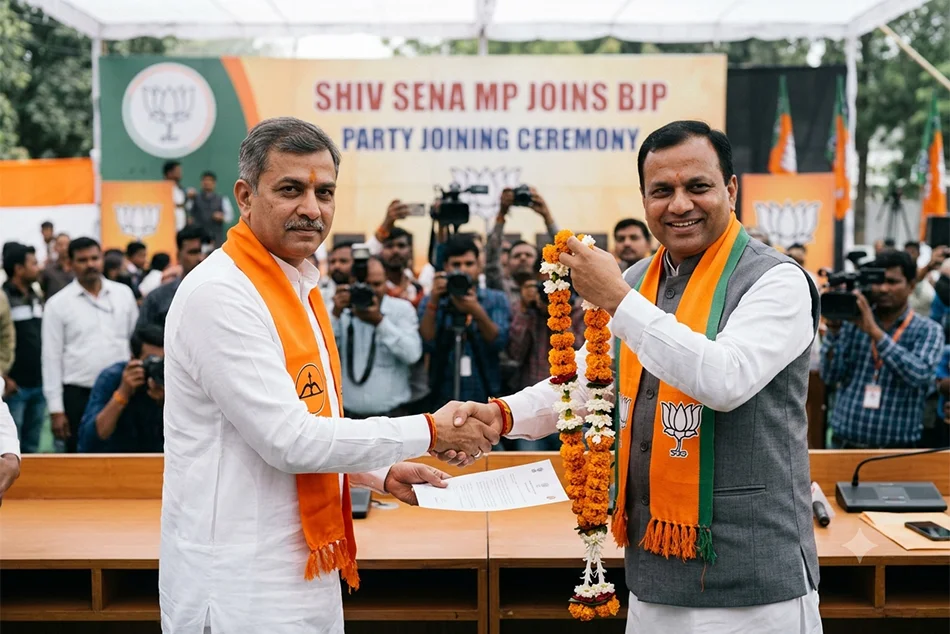
India’s elections are fought around parties, candidates, leaders, local issues and national narratives. Voters may have several reasons for choosing a candidate. But once the result is declared, the winning representative enters the legislature under the identity of the party on whose ticket the election was contested. A new analysis by the Association for Democratic Reforms (ADR) and National Election Watch shows how frequently that political identity can change after an election.
According to the report published on September 24, 2026, 111 sitting MPs and MLAs changed political parties after winning elections between 2022 and 2026. The figure includes 26 Lok Sabha MPs, 07 Rajya Sabha members and 78 MLAs. The number is significant not simply because of its size. It also raises questions about representation, political accountability and the effectiveness of India’s anti-defection law.
111 switched sides in four years
ADR’s analysis covers elections and by-elections during the period. Importantly, it does not treat every case as a simple individual defection. The cases include individual party switches, formal mergers, resignations followed by victories in by-elections, and disqualifications followed by winning a by-election. ADR also cautions that, because India does not maintain one comprehensive official database of such cases, its list may not be exhaustive.
Of the 111 lawmakers, 78 were MLAs, meaning state-level politics accounted for roughly seven out of every ten cases. The remaining 33 were members of Parliament. The concentration is particularly striking in a few states. Nagaland recorded 32 cases, the highest in the country. All were MLAs. Much of the movement involved the political realignment between the Nationalist Democratic Progressive Party (NDPP) and the Naga People’s Front (NPF). ADR says 25 lawmakers originally elected from the NDPP changed parties, while 32 joined the NPF.
West Bengal recorded 20 cases, all involving Lok Sabha MPs. According to ADR, all 20 were originally elected on All India Trinamool Congress tickets and subsequently moved to the Nationalist Citizens Party of India. The MPs have claimed a merger, and the issue is before Lok Sabha Speaker Om Birla.
Telangana recorded nine cases, involving BRS MLAs who moved, with Congress emerging as the principal recipient. Goa recorded eight cases involving Congress MLAs who moved to the BJP. Punjab also recorded eight cases, including six Rajya Sabha members and two MLAs.
Maharashtra recorded six cases, all involving Lok Sabha members elected from Shiv Sena (Uddhav Balasaheb Thackeray) who subsequently moved to the Shiv Sena led by Eknath Shinde, according to the ADR analysis.
The political traffic is not equal
The ADR data also shows that party switching has not been evenly distributed across political organisations. The largest number of lawmakers leaving a party came from the NDPP, with 25 cases. AITC accounted for 20 and Congress for 19. BRS accounted for nine, while AAP and NCP each accounted for seven. Shiv Sena (UBT) accounted for six. On the receiving side, NPF received 32 lawmakers, BJP 29 and NCPI 20. Together, these three parties accounted for 81 of the 111 lawmakers, or about 73 per cent of the cases in the ADR dataset.
These figures do not by themselves establish why an individual lawmaker changed parties. Representatives may cite ideological differences, political realignment, organisational considerations, constituency interests or other reasons. Those explanations need to be examined case by case rather than assumed. But the scale of movement makes a larger institutional question difficult to avoid.
What happens to the voter’s choice?
A voter does not vote in a political vacuum. The party symbol, manifesto, leadership, candidate and local reputation can all influence the decision. Research by Lokniti-CSDS has studied voter behaviour through large national and state-level surveys for decades. Its election studies examine the importance of parties, candidates and other factors in voting decisions.
A recent example illustrates the importance of the party label. A Lokniti-CSDS survey conducted around the 2025 Delhi Assembly election found that 57 per cent of respondents identified the party as the most important consideration in deciding whom to vote for. This does not mean that every Indian voter votes primarily for a party. Voters are different, and electoral choices vary across constituencies and elections.
Yet if a substantial section of voters considers the party important, a post-election switch can change the political identity under which a representative was elected. That is the heart of the debate.
India already has an anti-defection law
India introduced the anti-defection law through the 52nd Constitutional Amendment in 1985, which added the Tenth Schedule to the Constitution. The basic idea was straightforward: elected legislators should not be able to freely cross the floor and undermine elected governments.
Under the Tenth Schedule, a legislator can face disqualification for voluntarily giving up membership of the political party or for voting or abstaining contrary to the party’s direction, subject to the provisions of the Schedule.
The law was later strengthened through the 91st Constitutional Amendment, which removed the earlier protection associated with smaller splits and retained the merger exception under specific conditions. Yet nearly four decades after the anti-defection law was introduced, defections remain a recurring feature of Indian politics.
The law solved one problem but created another
Academic research suggests that the anti-defection law has produced complicated results. A 2024 article in the International Journal of Constitutional Law by Madhav Khosla and Milan Vaishnav examined India’s experience with anti-defection provisions. The researchers argue that while restrictions on floor crossing can limit political fragmentation, they can also strengthen party leadership and constrain the independence of legislators.
Another study published in Parliamentary Affairs examined whether anti-defection laws achieve their intended objectives. It argued that such laws can have a major effect on representative decision-making while not necessarily delivering the stability they were designed to guarantee.
This creates a difficult balance. If legislators are completely free to change parties, governments can become vulnerable to political bargaining and instability. But if party discipline becomes too strong, elected representatives may have limited freedom to disagree with their own leadership. The challenge is therefore not simply stopping every political movement. It is creating rules that protect both government stability and democratic representation.
There is another side to the story
Party switching should not automatically be treated as proof of wrongdoing. Political parties can split. Alliances can change. Ideological disagreements can become serious. Parties themselves can merge.
A representative may believe that remaining with the original party no longer reflects the political position they were elected to represent.
There are also situations where voters subsequently approve a changed political affiliation through a by-election. This is why ADR’s inclusion of resignations followed by by-election victories is important.
In such cases, the electorate gets another opportunity to express its choice. But the process can still be controversial when representatives change sides without immediately seeking a fresh mandate.
The economic and political consequences
The issue is not confined to constitutional law. A 2023 study in the European Journal of Political Economy examined political defectors in India. It estimated that 10–30 per cent of Indian MLAs are defectors, depending on the period and definition used. The study also examined the relationship between defection and political careers and economic outcomes.
The study reported associations between electing defectors and economic growth, while also finding that defectors were two to three times more likely to become government ministers than non-defectors. Such findings show why defections need careful study rather than simple moral judgments. If changing parties can improve political prospects, the incentives surrounding defection become an important part of understanding Indian politics.
The real issue is accountability: The Final Thought
The 111 cases should therefore not be viewed merely as a list of politicians who switched from one party to another. They point towards a larger question: who ultimately owns an electoral mandate - the individual representative, the political party, or the voters?
India’s Constitution gives elected representatives a formal position within political parties while the 10th Schedule places limits on their ability to cross the floor. At the same time, voters remain the ultimate source of electoral legitimacy.
A healthy democratic system needs all three elements to work together. Political parties need internal democracy. Legislators need some room for genuine disagreement. Voters need clarity about whom and what they are voting for. And when an elected representative fundamentally changes political allegiance, the public deserves transparency about the reason and the constitutional process that follows.
The ADR numbers provide a useful warning sign, but they are not, by themselves, a verdict on every individual case. The larger lesson is simpler: an election should not end when the votes are counted. Accountability must continue throughout the representative’s term. If political loyalties can change after voters have made their choice, India’s democratic institutions must ensure that the voter does not become the forgotten participant in that political realignment.
[The writer, Mohd Ziyauallah Khan, is a freelance content writer & editor based in Nagpur. He is also an activist and social entrepreneur, co-founder of the group TruthScape, a team of digital activists fighting disinformation on social media.]
Follow ummid.com WhatsApp Channel for all the latest updates.
Select Language to Translate in Urdu, Hindi, Marathi or Arabic