India’s Medical Tourism Push Has A Doctor Problem
Commerce and Industry Minister Piyush Goyal’s target of 10 million medical tourists a year won’t create new capacity in Indian healthcare, it will pull capacity out of a public system that’s already short on it
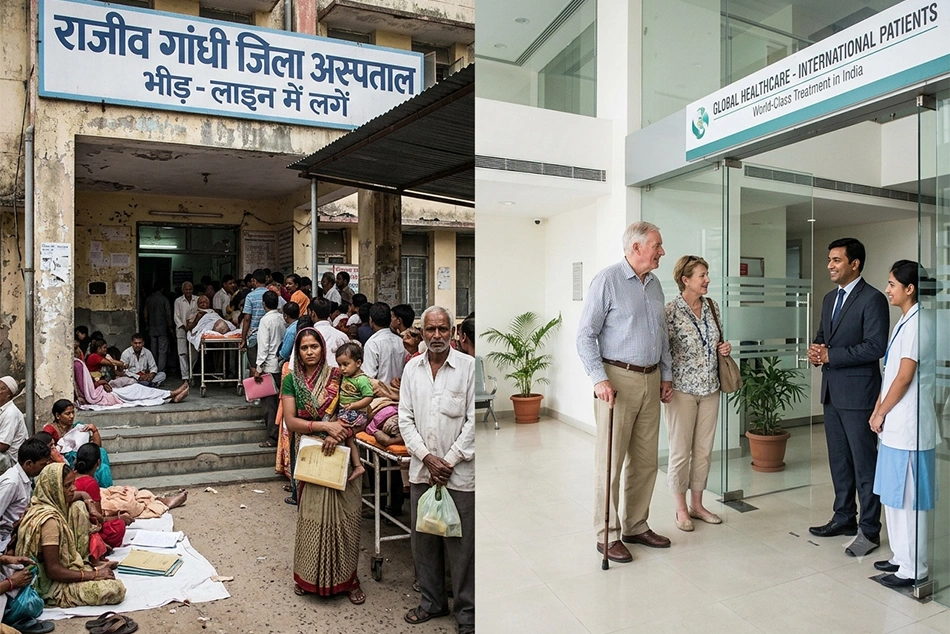
Commerce and Industry Minister Piyush Goyal’s target of 10 million medical tourists a year won’t create new capacity in Indian healthcare. It will pull capacity out of a public system that’s already short on it. That’s not really an opinion. It’s just arithmetic that nobody in the room that day wanted to say out loud.
Start with what’s actually scarce. India spends 1.9% of GDP on public health, according to the 2023-24 Economic Survey. That’s still below the 2.5% target the government set for itself back in 2017, a target that keeps getting pushed further out. The country has 1.3 hospital beds per 1,000 people, against a WHO recommendation of 3.5. The doctor-to-patient ratio nationally is about 1:1,456, worse than the WHO’s 1:1,000, and it gets much worse once you leave the big cities.
Bihar and Jharkhand have the lowest doctor density in the country. Primary health centres nationwide are short-staffed by roughly 31%. This is the foundation Goyal wants to build “10 million patients a year” on top of.
Medical tourism doesn’t add doctors to that foundation. It moves the ones who already exist, and it moves them upward, toward big private hospitals in Delhi, Chennai, and Mumbai, the ones equipped to offer treatment at “60 to 80 per cent” less than what it costs abroad. A heart surgeon doing three foreign-patient surgeries a week in Chennai isn’t taking a posting in rural Jharkhand.
The bioethicist Leigh Turner has written the most detailed academic critique of medical tourism’s economics, and he documented exactly this in Thailand in the early 2000s: as Bumrungrad Hospital expanded to serve international patients, doctors were pulled out of provincial public postings and into private hospitals in Bangkok. Thailand had a working universal health scheme to soften that blow. India, spending under 2% of GDP on public health, does not.
Look closely at what Goyal actually asked for, and the same pattern shows up again. He wants faster insurance payouts and easier cashless billing built for the medical tourism pipeline. Compare that to an ordinary Ayushman Bharat patient, where slow reimbursements and disputes between hospitals and the government are common enough to have generated years of complaints and parliamentary questions. India isn’t incapable of building fast, simple insurance systems. It’s a question of who gets one first. Right now, that answer seems to be whoever pays in dollars.
The one part of Goyal’s plan that doesn’t take anything away from Indian patients is the proposed pool of interpreters. Nobody in rural Bihar needs an Arabic or Swahili translator at a clinic. But notice that’s also the cheapest, smallest item on the list. The two that actually cost real money and specialist time, faster payouts and cashless billing, are aimed outward, at foreign patients.
One honest qualification, and then I’ll move on. None of this means the money is worthless, or that Goyal is wrong that this sector creates jobs and brings in foreign currency. It clearly does. The 3.5 million patients he mentioned over the past seven years were real people spending real money in a real industry, and rejecting that on principle would be its own kind of empty gesture. The problem isn’t that the sector exists. It’s that tripling it, as stated government policy, with no matching plan for rural staffing or public-sector pay, is a choice to widen a gap that India’s own health data already shows clearly.
Here’s what would change my mind. A real requirement, not a suggestion, that hospitals taking part in the medical tourism scheme send a fixed share of specialist hours to rural or smaller-city postings, similar to what some states already require of doctors who trained on subsidized government seats. Goyal did talk about expanding to tier-2 and tier-3 cities, but he framed it as an airport problem, pointing to the roughly 165-170 airports built since 2014, on the way to 200. That’s a transport answer to a staffing question. More airports get foreign patients to Indian hospitals faster.
They do nothing about who’s actually in the operating room when those patients land, or who isn’t in a primary health centre in Chhattisgarh, where 71% of doctor posts sit empty, because the specialist chose the higher-paying option years ago. Tele-consultation, which Goyal also brought up, is the one idea here that could genuinely help in the other direction: a rural patient reaching a city specialist without either one traveling. Whether that actually happens depends entirely on whether that specialist’s time goes to a village clinic or to the next paying patient flying in from abroad. Nothing in the policy, as described, answers that either way.
There’s a real irony in Goyal calling for “ethics and integrity” as the price of reaching 10 million patients. In medical humanities, we usually use that language for the relationship between a doctor and a single patient: informed consent, continuity of care, not treating a sick person as just a source of revenue. Apply the same standard to national health policy instead of one appointment, and it asks a different question than the one Goyal answered. Not whether India’s hospitals can deliver excellent care to a paying visitor from abroad. They clearly can. The real question is whether a health ministry can call a policy ethical while it pulls its scarcest resource, specialist doctors’ time, away from the citizens who have the least ability to travel toward it.
[The writer, Rahul Banerjee, is a postgraduate student at the Department of English and Cultural Studies, Christ University, Bangalore. He is also doing research in Medical Humanities. You can contact the author at rahulbanerjeemishra@gmail.com.]
Follow ummid.com WhatsApp Channel for all the latest updates.
Select Language to Translate in Urdu, Hindi, Marathi or Arabic