Why Crime in India does not die, but Mutates
Crime in India does not collapse under new laws or shifting government, but mutates and absorbs pressure, adopts fresh disguises, and reappears inside the very institutions meant to contain it
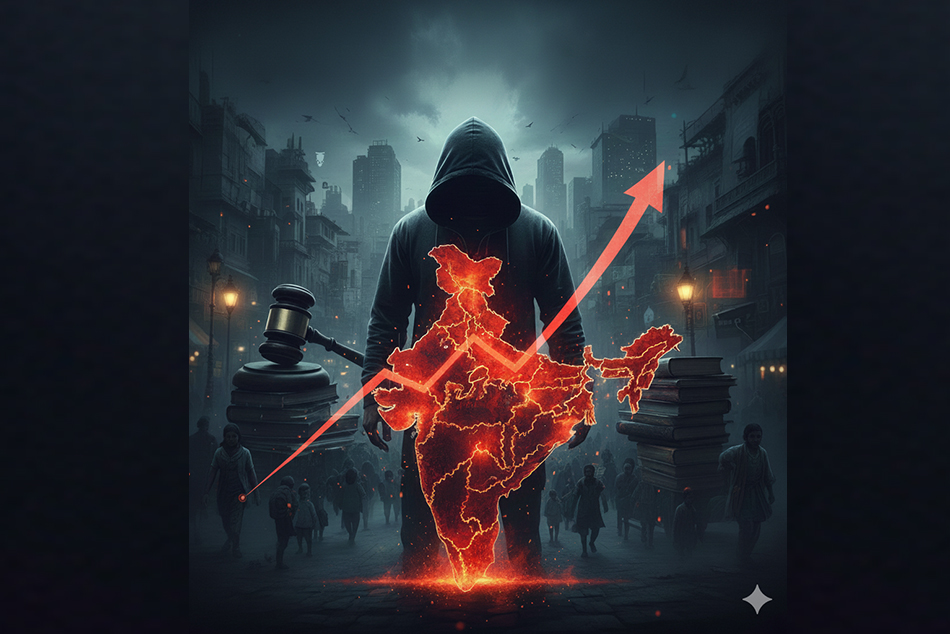
Crime in India does not collapse under new laws or shifting governments. It mutates. It absorbs pressure, adopts fresh disguises, and reappears inside the very institutions meant to contain it. The rituals change, the vocabulary becomes smoother, but the engine remains intact. What keeps that engine lubricated is not the criminal alone—it is the intermediary who stitches illegality into the system with practiced ease. It is the dalal, the discreet engineer of continuity.
Once upon a time, crime lived outside authority. Gangsters hid in ravines, smugglers in back alleys, and the state could at least pretend it was fighting them. Today crime lives indoors, in the climate-controlled corridors of offices, inside procurement files, behind encrypted chats and well-lit photo ops. The dalal has moved it there. He no longer deals in brute force; he deals in access. He replaces intimidation with introductions, violence with familiarity. His authority comes not from fear but from being indispensable.
The dalal’s world has expanded with remarkable stealth. What began as nudging land disputes or smoothing FIR entries has matured into orchestrating reputational laundering for tainted public figures, choreographing selective raids, managing leaks, and turning government approvals into silent auctions. He has mastered the art of making wrongdoing appear procedural. Whenever crime begins to speak the language of development or patriotism, it is the dalal who has rehearsed the lines.
The modern criminal now requires invisibility more than muscle, legitimacy more than infamy. The dalal provides both. Politicians use him for deniability, bureaucrats for shortcuts, institutions for convenience. Criminals use him for protection. In this relationship, each side gets exactly what it wants: crime is made effortless, and the dalal becomes its permanent translator.
The media has become one of his most effective tools. A new species of dalal-journalists—reporters by profession, brokers by instinct—now performs the narrative surgery that crime requires. They delete, distort, dramatize, and redeem. They convert petty offenders into local icons and seasoned criminals into misunderstood patriots. They turn the public sphere into a fog machine where accountability loses its shape. Crime, thanks to them, is no longer hidden; it is curated.
This constant bypassing of process erodes institutions grain by grain. Police stations slip into consultancy mode, where influence writes the FIR. Courts begin to move in rhythms that mimic electoral cycles. Contracts are awarded long before tenders open. Universities become recruitment centers for loyalists. Land mafias grow faster than the crops they displace. And the digital noise produced by dalals ensures that public memory remains too disoriented to resist.
The face of crime keeps changing. The structure that feeds it does not.
Crime persists because the dalal is system-proof. Governments rise and fall, reformist slogans bloom and fade, but the dalal survives all seasons. He has no ideology, no loyalty, no permanent master—only permanent opportunity. He knows every corridor, every backdoor, every pressure point. He evaporates when threatened and condenses again when the moment is right. He is continuity personified.
If crime is to weaken, the dalal’s network must be starved. Institutions must offer direct access instead of mediated access. Police and investigative bodies must be insulated from political appetite. Media must break free from dependency on favours. Citizens must not be forced to navigate the state through fixers.
Crime in India has not vanished; it has merely been repackaged. It wears cleaner clothes, uses official vocabulary, and occasionally poses as a reformer. But beneath this polish lies the same machinery of exploitation—maintained and modernized by the person who stands at the corridor’s edge with a ready smile and a deeper contact list.
Crime does not die.
It adapts.
And it adapts because someone helps it survive.
That someone is the Dalal.
Follow ummid.com WhatsApp Channel for all the latest updates.
Select Language to Translate in Urdu, Hindi, Marathi or Arabic