The Emir Who Knew When and Why to Relinquish Power
For all the ports, towers, investments and diplomatic initiatives associated with his reign, Sheikh Hamad bin Khalifa Al Thani’s most radical act was not something he built. It was something he relinquished
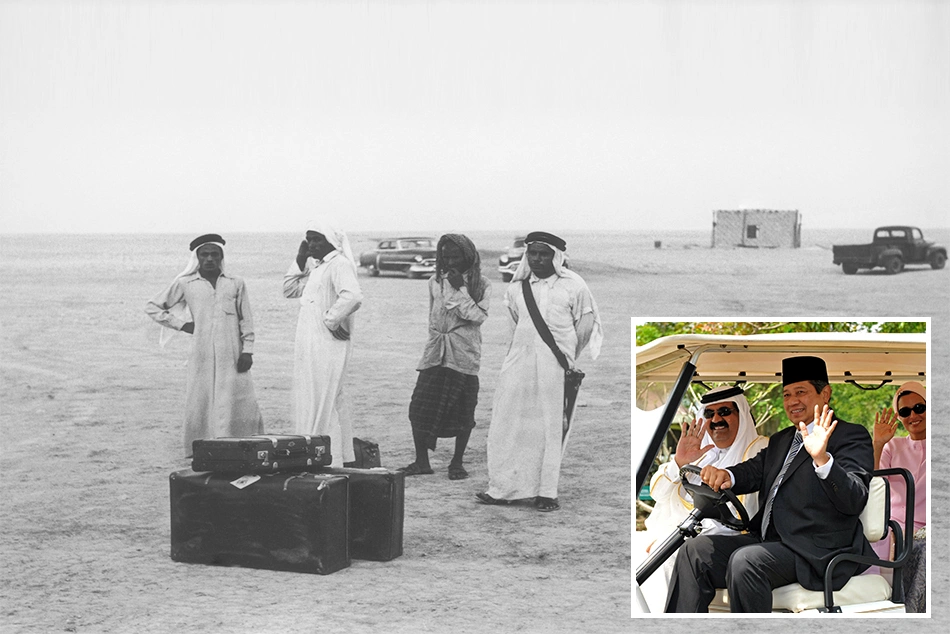
[Souq Waqif, Qatar in 1960. (Inset) Sheikh Hamad bin Khalifa Al Thani with former President of Indonesia Susilo Bambang Yudhoyono. (File)]
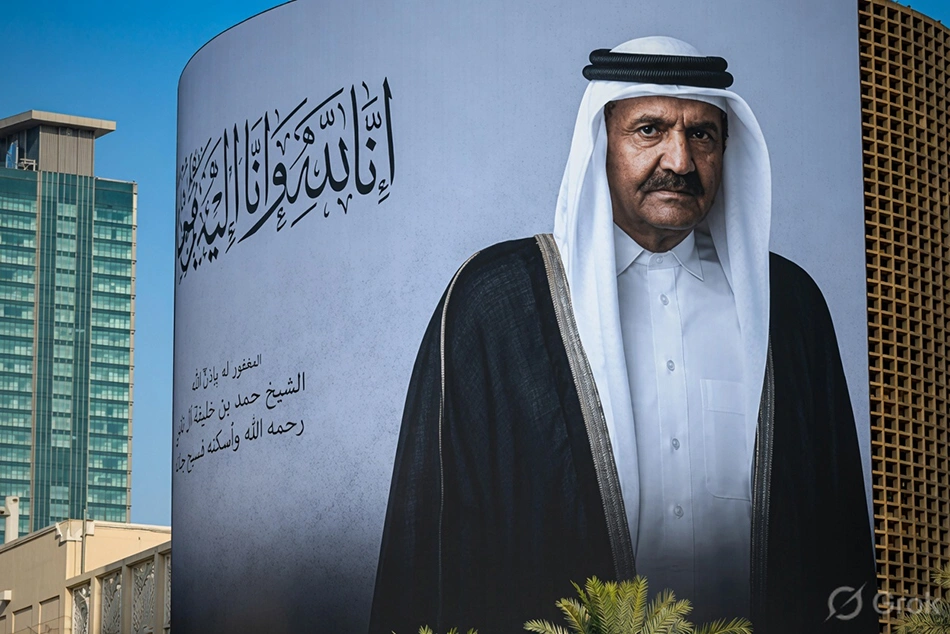
When I moved to Doha in 2008, I found a country that behaved like a permanent construction site. Cranes crowded the skyline. Roads were being cut through the desert, ports enlarged, universities opened and institutions raised almost from nothing. At the centre of this transformation stood one man: Sheikh Hamad bin Khalifa Al Thani, the Father Emir, who died on Sunday at the age of 74.
Of everything I watched take shape, one place stayed with me:
Souq Waqif.
After fire damaged part of the old market in 2003, the predictable course would have been to clear it away and replace it with another monument of glass and steel. Sheikh Hamad chose the opposite. The restoration was entrusted to the Qatari Artist and Architect Mohammed Ali Abdullah, who studied old photographs, removed layers of concrete that had accumulated over the decades and recovered the market’s earlier architectural language: mud plaster, timber, stone, narrow lanes and shaded courtyards.
Completed in 2008, the project was shortlisted for the 2010 Aga Khan Award for Architecture. Its achievement was not to preserve the market as a museum piece, but to return it to life.
What I had first taken for a ruler’s aesthetic preference was, in fact, a doctrine:
Modernise without erasing; Preserve a place’s soul rather than merely its shell.
I saw Sheikh Hamad walk those lanes with his grandchildren, accessible enough for passers-by to approach and greet him, without the conspicuous cordon one might expect around a Gulf sovereign. In that setting, surrounded by merchants, families, falcons, spices and the accumulated memory of Doha, power appeared almost ordinary.
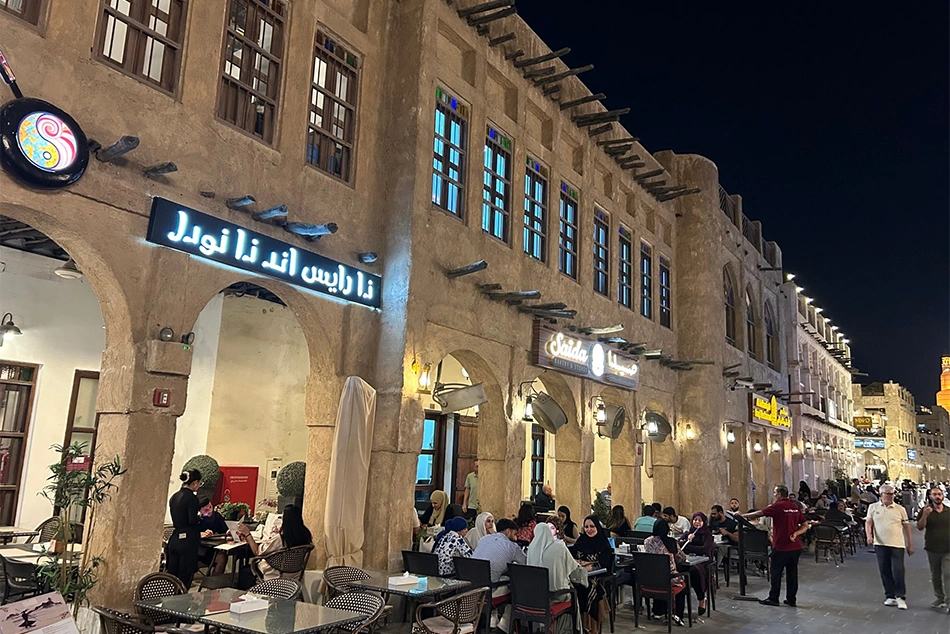
[Souq Waqif today]
Elsewhere, the scale of what he built was harder to overlook.
He turned Qatar’s vast offshore gas reserves into one of the world’s most formidable liquefied-natural-gas industries and transformed a little-known Gulf state into one of the richest countries per capita. The Qatar Investment Authority accumulated assets across continents, while other state-backed vehicles extended Qatar’s reach into sport, media, aviation, property and culture.
He made a small peninsula into a diplomatic broker, mediating in conflicts from Lebanon to Darfur. In October 2012, he became the first head of state to visit Gaza after Hamas had taken control of the territory and the blockade had tightened around it. In December 2010, he stood in Zurich as Qatar won the right to host the 2022 World Cup — an audacious victory for a state that many people could scarcely locate on a map.
Al Jazeera may have been his most consequential creation. Founded in 1996 with his backing, it shattered the ritual deference of Arab television. It brought presidents, generals, dissidents and ideologues into the same argumentative space and gave the Arab public a voice it had rarely heard on its own screens: contentious, unruly and unwilling to whisper.
But honesty requires that Sheikh Hamad not be remembered only through the restored lanes of Souq Waqif or the triumphs of statecraft.
He came to power in June 1995 through a bloodless palace coup while his father was abroad. He ruled with the concentrated authority of an absolute monarch. The reforms introduced under him — a constitution, municipal elections and a wider public role for women — were significant, but they were conferred from above rather than secured through democratic contest.
Al Jazeera challenged nearly every government in the Arab world, yet seldom subjected the political structure that financed it to comparable scrutiny. The World Cup that crowned Qatar’s ambitions also intensified international scrutiny of the conditions endured by migrant labourers.
And Sheikh Hamad’s determination to preserve an independent foreign policy — maintaining relations with Iran, receiving Hamas leaders and allowing the Taliban to establish a political office in Doha — helped produce the regional tensions that culminated, four years after his abdication, in the blockade imposed on Qatar by neighbouring states.
To acknowledge these contradictions is not to diminish his achievement. It is what allows that achievement to be judged seriously.
For all the ports, towers, investments and diplomatic initiatives associated with his reign, Sheikh Hamad’s most radical act was not something he built. It was something he relinquished.
On 25 June 2013, while still in command of the state and under no evident compulsion, he abdicated in favour of his son, Sheikh Tamim bin Hamad Al Thani.
The rarity of that decision is easy to underestimate. In a region where power is commonly held until death, overthrow or incapacity, a ruler who voluntarily leaves the throne while still capable of occupying it represents an anomaly. Sheikh Hamad did not merely designate a successor. He allowed succession to happen.
That distinction matters.
Many rulers prepare heirs but never permit them to inherit. They create institutions but remain larger than those institutions. They speak of continuity while organising the state around their own continued presence. Their countries become extensions of their personalities, and transition becomes a crisis because departure was never admitted into the architecture of power.
Sheikh Hamad chose otherwise.
The man who had refused to erase the memory of the merchants, craftsmen and families embodied in Souq Waqif accepted that a country’s future could not remain permanently arranged around his own person. He surrendered the central place he had occupied and stepped away from government while still alive to witness what Qatar would become without him at its helm.
This was not disappearance. He remained the Father Emir, visible at national occasions and deeply respected. But he no longer governed. The distinction between influence and authority, between being honoured and being obeyed, was one he appeared willing to accept.
States rarely outlive rulers who confuse the nation with themselves. The greatest builders, therefore, may not be those who construct the most, but those who know when their work must be allowed to stand without them.
The irony was gentle.
When Qatar finally opened its World Cup in 2022, Sheikh Hamad entered the stadium not as the reigning sovereign who had secured the tournament, but as the retired Father Emir who had entrusted its completion to another generation. The ovation he received belonged not simply to a former ruler. It belonged to the man who had imagined the moment, worked to make it possible and then accepted that someone else would preside over it.
That is the image I retain of him.
Not the sovereign seated at summits, nor the statesman surrounded by flags, but a man walking through a market lane with a child’s hand in his, allowing the place — its walls, its merchants, its memories — to speak in his stead.
He built a great deal. More unusually, he permitted what he built to cease belonging to him.
In a world that still measures power by its duration and greatness by the number of years a leader remains indispensable, Sheikh Hamad bin Khalifa Al Thani offered another measure:
The final test of a builder is not whether he can raise a state around himself, but whether he can leave it standing after he has gone.
And the highest act of power may be the one power fears most: knowing when to let go.
[The wrtiter, Laala Bechetoula, is an independent Algerian historian, journalist and geopolitical analyst. He is a Research Associate at the Centre for Research on Globalization (CRG), Montreal, and the author of The Book of Gaza Hashem.]
Follow ummid.com WhatsApp Channel for all the latest updates.
Select Language to Translate in Urdu, Hindi, Marathi or Arabic