Onam: Kerala's Iconic Festival is Back in All its Beauty and Grace
Malayalis’ eagerly-awaited annual festival Onam stands out as one of the few celebrations in the world that blends mythology, veneration of nature and cultural expressions in a captivating tapestry.
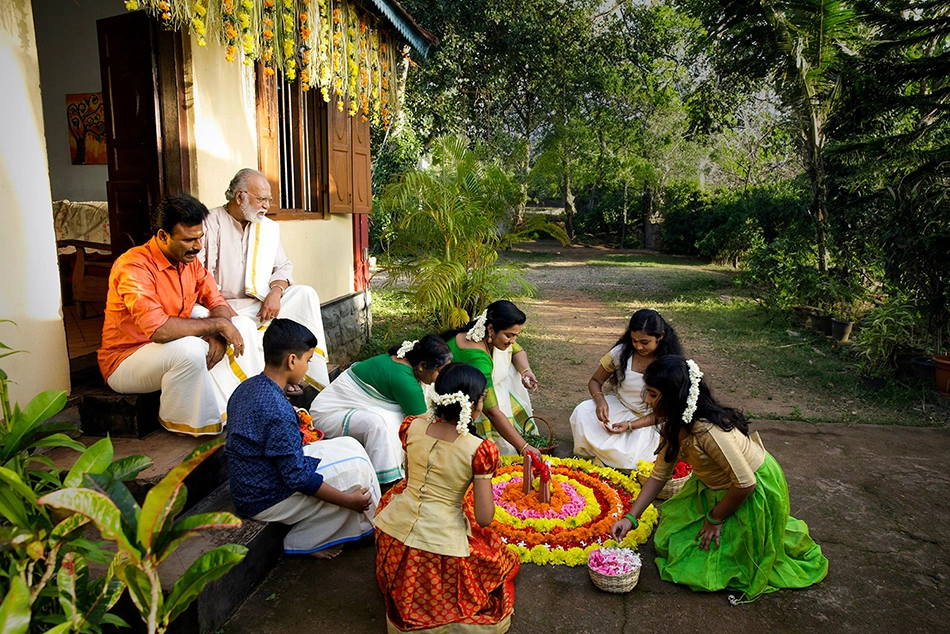
[The Pookalam is a roundish flower-carpet, typically arranged by the children and women on the front yard of their house. Laid soon after the break of day, the Pookalam is centered by the cube-shaped clay idols called Thrikkakarayappan.]
Malayalis’ eagerly-awaited annual festival Onam stands out as one of the few celebrations in the world that blends mythology, veneration of nature and cultural expressions in a captivating tapestry.
This year, the ten-day Onam season started on August 16 with the day of Atham in the traditional calendar, bringing in its wake a zealously-preserved tradition celebrated by Malayalis since ancient times, cutting across social and economic barriers. The festival culminates with the ‘Thiruvonam’ Day on August 26.
Onam is defined by its beauty, grace, charm and inclusivity. Though at its core is a Hindu myth, Onam is a festival that blurs borderlines of faith and social rankings. The festival is deeply ingrained in the socio-cultural ethos of Malayalis, whether they live in Kerala or in any part of the world.
Onam, which falls in the month of ‘Chingam’ in the Malayalam calendar, comes after three months of southwest monsoon, with fresh shoots springing from the bowels of Mother Earth. For an agricultural community, which Kerala essentially was until not-so-distant past, the season implied the paddy harvest time.
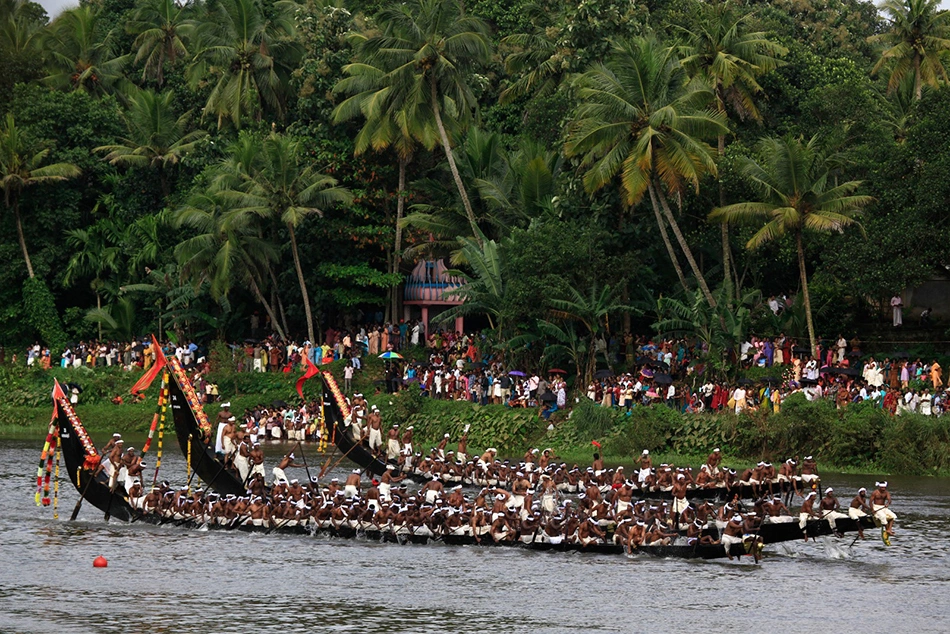
[Vallamkali, or boat-race, is a fiercely-contested friendly water-festival during Onam. Snake-boats, measuring 120 feet and with 80-plus paddlers, row with full spirit and energy to emerge first at the races that are key to the occasion, more so in the southern coastal districts.]
The Mahabali Myth
Onam has a legend behind to it. The region comprising Kerala was eons ago ruled by the Asura King Mahabali. So ideal was his reign that the kingdom was like a paradise on earth—no trace of lie, deception or malice of any kind.
Could such harmony be allowed to flourish in the mundane world? Of course, it made the Devas envious. They hatched plans to bring an end to the golden era. Instigated by them, Lord Vishnu transfigured into a dwarf (Vamana) and came down to Mahabali. Always keen to welcome guests, the king expressed his willingness to grant anything the visitor would request.
The dwarf asked for three steps of earth. Mahabali agreed. Ahead of taking his first step, Vamana suddenly grew in size to emerge like a titan. Thus, his one foot covered the whole of earth, the second the whole of heaven. As there was no ground left, Mahabali offered his head for the dwarf to place his foot on a third time. The emperor was stomped down to the netherworld (Patal). Resolved to his downfall, the king asked for a favour: “Can I visit my subjects once a year?” Yes, said Vishnu generously. And that’s the Onam season, the homecoming of Mahabali every year, to be welcomed by his subjects with all honours.
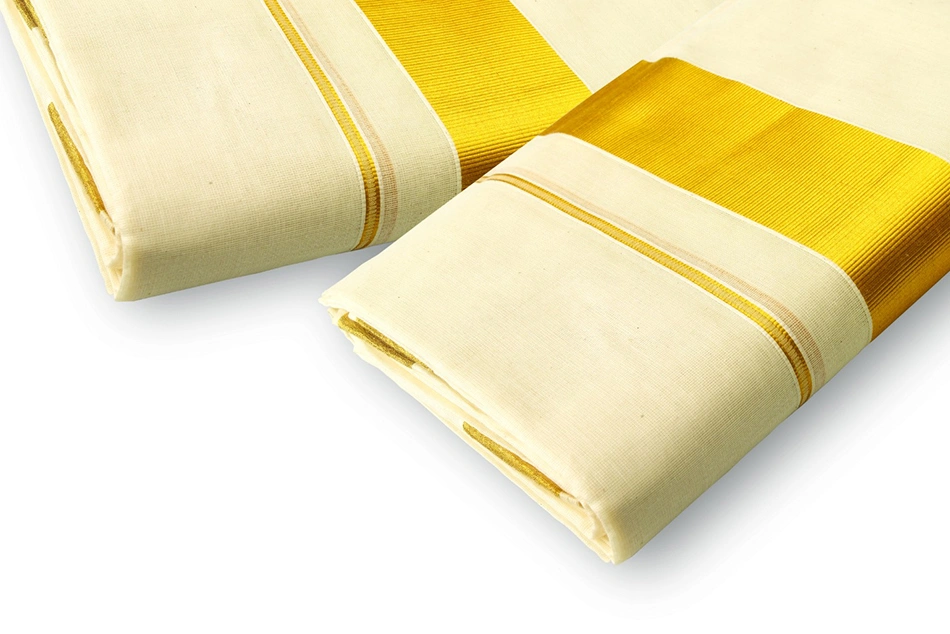
[The traditional set-mundu, which is the women’s wear during Onam festivities. A pair of off-white cloth-pieces, one will go round the waist while the other slings above the left shoulder to dangle down like a sari. The set-mundu borders come in different colours and embroidered designs, but the most classical of them is the golden brocade called Kasavu.]
Floral Carpet
The most enduring and colourful image of Onam is the tradition of laying out floral carpets to welcome Mahabali. It is also known as ‘Atha Pookkalam’ as it starts at homes on the ‘Atham Day’, 10 days ahead of Thiruvonam.
These days Onam has assumed a larger social dimension, with festivities spilling over to community cultural spaces. So, Pookkalam is laid out in schools, offices and even tech campuses.
A visitor to the state during Onam is greeted with the Pookkalam, laid out with a variety of flowers adorning the front yard of homes. Members of families, including little ones, give full play to their aesthetic sensibility in making the floral carpet. With fast-paced urbanisation turning vast swaths of land into concrete jungles, the flowers for Pookkalam now mostly come from neighbouring states.
Onam Sadhya, the Multi-Dish Feast
The Onam Sadhya, the multi-dish feast served on a plantain leaf, is a delicious highlight of the festival. Traditionally, the Sadhya used to be prepared by women at home, with the menfolk lending a helping hand to fry banana chips and fritters.
The dishes, laid out on banana leaves, are vegetarian . Rice, sambhar, avial, rasam, olan, erissery, pappadam, fried banana chips and pickles make the list pretty long, along with savouries like sweet ‘pradhaman.’ In parts of the Malabar region (north Kerala), fish and meat are also added to enliven the menu.
These days, the full-course Sadhya—complete with the banana leaf—gets delivered directly to homes. Scores of restaurants and caterers make a roaring business during the season. Onam Sadhya is available in major restaurants and star hotels during Onam across major cities in India, as well as in the Middle East, the USA, and the UK.
Women at the Centre of Festivities
Onam has always been a time for people to engage in arts and sports, seeing the return of many cherished traditions. At a time when women were essentially homemakers, Onam was an occasion for them to express their artistic talents, traditionally before family audiences.
There are choreographic expressions like Kaikottikali, in which dancers clap their hands in unison while moving clockwise and anticlockwise rhythmically. The themes are drawn from Hindu mythology; however, an offshoot in Christian homes is called Margamkali, where the lyrics are largely Biblical. The Islamic tap-and-sing traditions of DuffMuttu and Arbanakali are also popular.
Sporting Season for Men and Children
In parts of Kerala, Onam offers an occasion for men to display physical prowess by engaging in a pastime fight called Onathallu, which has its combat tactics borrowed from the martial art of Kalaripayattu.
They also engage in many other rural sports.
Community Cultural Spaces and Tourism Week
From home grounds, these cultural expressions have moved to community spaces. The State Government organises Onam Celebrations on a grand scale for a whole week in the state capital, district headquarters, and cities and towns across the state. In suburban and rural areas, local cultural outfits take the lead in organising the festival.
The season also sees a massive inflow of tourists to Kerala. For hosting and taking them around the festival venues, the Tourism Department has made special arrangements.
“The week-long celebrations will showcase Kerala's cultural diversity, traditions, artistic heritage and tourism potential. The celebrations are aimed at presenting Kerala's traditional and cultural heritage along with its tourist attractions,” said Tourism Minister Shri P. C. Vishnunadh.
The Onam season also provides the visitors an opportunity to experience the eclectic culture of the people, the Minister added.
This year, the week-long Tourism Week Celebrations, organised by the Tourism Department, will be inaugurated by Kerala Chief Minister Shri V. D. Satheesan in the presence of the Tourism Minister, along with Malayalam film actor Kunchako Boban in Thiruvananthapuram on August 24. The celebrations, dominated by cultural programmes and the illumination of main thoroughfares and landmark buildings, will conclude with a grand, colourful pageantry on August 30.Vice President of India Shri C P Radhakrishnan will flag off the cultural procession.
Boat Races
Onam is also the season of boat races. Kerala has a string of sprawling backwaters. The Travancore region—especially the rice-bowl of low-lying Kuttanad—serves as the hub of boat races. The prime attraction is the chundanvallam: snake-boats, as long as 140 feet and accommodating 120 paddlers. There are also smaller vessels, enabling women to contest as well.
Ironic Twist
Though Onam is primarily a festival that welcomes the return of Mahabali, in some regions the celebrations also take on an ironic twist. For many, it is also an occasion to worship Maha Vishnu, who transfigured as Vamana to banish Mahabali to the netherworld.
As part of this tradition, clay cubes that are made, and floral offerings are placed at its base. This ritual is called worshipping Thrikkakarayappan , representing Lord Vishnu, who is believed to have ended the mythological Mahabali regime. However, this in no way dampens the festive spirit, whose core focus remains the joyous homecoming of Mahabali.
Follow ummid.com WhatsApp Channel for all the latest updates.
Select Language to Translate in Urdu, Hindi, Marathi or Arabic