How Yogi Govt in UP Turned Taxpayers’ Money into Political PR Machine
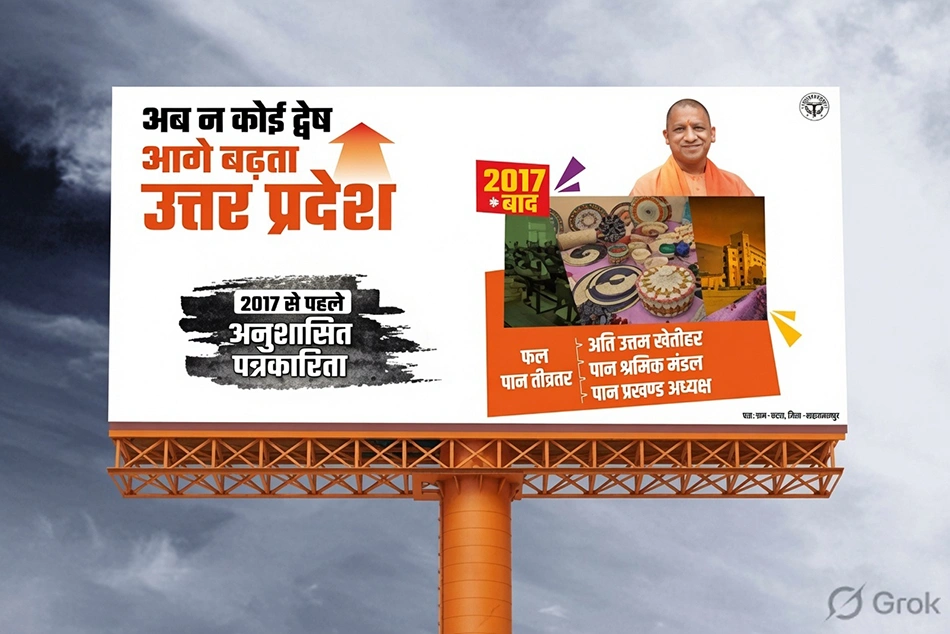
The Uttar Pradesh government’s reported expenditure of ₹6,811.94 crore on advertisements over eight years is not merely a financial statistic it is a stark indictment of misplaced priorities and the growing use of public money for political image-building
Introduction
In every democracy, governments have a legitimate responsibility to inform citizens about welfare schemes, public health campaigns, disaster warnings, and development initiatives. However, an equally important democratic principle is that taxpayers’ money should never become a vehicle for political self-promotion.
A recent investigative report by Newslaundry, based on official government data, has reignited this debate. According to the report, the Uttar Pradesh government under Chief Minister Yogi Adityanath spent ₹6,811.94 crore on publicity and advertisements between 2017 and 2025 an average of approximately ₹2.32 crore every day. The report also states that this daily expenditure exceeds comparable daily averages often cited for the Union government’s advertising during the Narendra Modi era.
If these figures accurately reflect total government publicity expenditure, they raise significant questions—not only about financial priorities but also about transparency, accountability, and the increasingly blurred line between public communication and political branding.
The Numbers Behind the Campaign
According to the Newslaundry investigation based on official expenditure records:
- Uttar Pradesh (2017–2025) Advertisement Expenses
- Category
- Total publicity expenditure: ₹6,811.94 crore
- Average annual expenditure: ~₹851 crore
- Average daily expenditure: ~₹2.32 crore
- Visual, print and digital publicity: More than ₹5,658 crore (over 83%)
The report further notes that expenditure accelerated sharply after the COVID-19 pandemic, with annual publicity spending reportedly crossing ₹1,100 crore in multiple years. The scale naturally invites scrutiny over whether this increase reflected expanded public-information needs or a broader communications strategy centered on government image.
Is it Public Information or Political Branding?
Government advertising is not inherently problematic. Citizens need information about:
- Vaccination campaigns
- Welfare schemes
- Disaster preparedness
- Agricultural support
- Employment programmes
- Public safety announcements
The challenge arises when government-funded campaigns prominently feature political leadership, slogans, branding, or messaging that resembles electoral promotion rather than neutral public information.
The Supreme Court of India addressed this concern in Common Cause v. Union of India (2015), emphasizing that publicly funded advertisements should primarily educate citizens and avoid functioning as instruments of political glorification. Following the judgment, guidelines were framed to limit the use of public funds for personality-centric publicity.
Although those guidelines have evolved through later court orders and committee recommendations, the underlying constitutional principle remains: public money should primarily serve public information, not partisan advantage.
The Transparency Question
One of the most significant issues raised in reporting is not merely the amount spent, but the difficulty in independently examining where the money ultimately went. According to the Newslaundry investigation, efforts to obtain detailed recipient-wise expenditure records through the Right to Information Act reportedly did not produce complete disclosures.
Transparency matters because taxpayers have legitimate questions:
- Which media organisations received advertising revenue?
- What criteria governed allocation?
- Were allocations proportional to audience reach?
- Were independent or critical media treated differently?
- How much went to digital platforms compared with traditional media?
Without detailed public disclosure, it becomes difficult for citizens, researchers, and auditors to evaluate whether expenditure decisions were objective and equitable.
Advertising and Democratic Accountability
Government advertising occupies a unique position within democratic systems. Unlike commercial advertising, governments spend taxpayers’ money rather than private capital. This imposes a higher ethical standard.
Researchers have long warned that discretionary allocation of government advertising can influence media incentives, particularly where advertising revenue forms a substantial share of operating income. However, with the BJP in power in the UP state has gone far beyond the budget, which Modi spends per day in his personal and party branding.
Reports suggest that the Union Government under Prime Minister Narendra Modi spends an average of approximately ₹1.5 crore per day on publicity and advertising. For instance, it has been reported that in a recent event in Andhra Pradesh, more than 13,000 school and college students participated in performances to welcome the Prime Minister, which has raised questions in public discourse about the use of public resources for large-scale event management and associated expenditures.
Similarly, reports based on official data indicate that the Uttar Pradesh government under Chief Minister Yogi Adityanath spends an average of approximately ₹2.32 crore per day on publicity and advertisements, funded through taxpayers’ money. These figures have contributed to ongoing debates about the scale and purpose of government communication spending. Critics argue that such high levels of expenditure on publicity and event-related activities raise concerns about prioritisation of public funds and the need for greater transparency and accountability in government spending decisions.
International organisations including UNESCO and media-freedom groups have argued that opaque distribution of state advertising can create risks for editorial independence, especially when allocation lacks transparent criteria. However, these concerns fall on deaf ears as far as Indian political ruling regime is concerned, and no one wants to raise this including the opposition, which seems meek when compared to the mighty BJP. The concern is structural rather than jurisdiction-specific: governments should avoid creating incentives that may affect independent journalism. And the fact is it has already affected which has given birth to the idea of Godi Media.
Opportunity Costs
Every rupee allocated to publicity is unavailable for other public priorities. While governments must communicate with citizens, expenditure choices inevitably raise questions about competing needs. The fact is the priority is missing when it comes to governance, the ruling regime is only busy in promoting itself wasting taxpayers’ money, without even paying a heed on important issues. Governments should more likely to address sectors like:
- Government schools
- Primary healthcare
- Rural infrastructure
- Sanitation
- Nutrition programmes
- Teacher recruitment
- Public hospitals
- Road maintenance
A complete assessment requires examining whether communication spending delivered measurable public benefits commensurate with its cost.
However, the supporters of the Uttar Pradesh government or the Bhakt camp argue that large-scale communication is necessary in a state of over 240 million people.
They contend that:
- Awareness campaigns increase uptake of welfare schemes;
- Digital and multimedia outreach reaches remote populations;
- Publicity helps citizens understand eligibility and application procedures; and
- Sustained communication is essential for effective governance.
These arguments may sound in a legitimate public-policy perspective, however, this is not the case. Governments in the name of having the obligation to inform citizens is singing its tune to set their own narrative while patting its back as it fails to improve programme participation of the common man. The fact is there seems to be a freebie culture around these schemes that can capitalized during the elections. With elections in UP next year, just wait to see more such announcements coming from the state government which will fill the account holders in UP like we have seen in Maharashtra, Bihar and Delhi state elections.
The central question is therefore not whether governments should advertise, but whether the scale, content, and execution represent the most effective and accountable use of public resources.
The Broader National Context
Government advertising has expanded across India over successive administrations at both Union and state levels. This broader trend has prompted recurring debate over:
- Limits on publicity expenditure;
- Independent oversight;
- Transparent allocation mechanisms;
- Disclosure of beneficiaries; and
- Separating public information from political messaging.
Many public-finance experts have suggested that detailed annual disclosure of advertising expenditure including recipients, campaign objectives, and outcome metrics would strengthen public trust. However, despite all these reports made available for the government, little did the ruling regime has paid a heed on its implementation and accountability.
Toward Greater Accountability
A constructive way forward would include:
- Proactive publication of recipient-wise advertising expenditure;
- Independent audits of communication campaigns;
- Measurable evaluation of campaign effectiveness;
- Objective media allocation criteria;
- Periodic legislative scrutiny; and
- Clear distinction between informational content and personality-centric promotion.
Such measures would not prevent governments from communicating with citizens. Instead, they would help ensure that communication serves public interest while reinforcing democratic accountability.
Conclusion
The Uttar Pradesh government’s reported expenditure of ₹6,811.94 crore on advertisements over eight years is not merely a financial statistic it is a stark indictment of misplaced priorities and the growing use of public money for political image-building. At a time when millions continue to struggle with inadequate healthcare, underfunded schools, unemployment, and crumbling civic infrastructure, diverting thousands of crores to publicity raises serious questions about governance and fiscal responsibility.
Governments have a duty to inform citizens, but public communication cannot become a vehicle for self-promotion at taxpayers’ expense. Every rupee spent on advertising is a rupee denied to essential public services unless its necessity and impact are transparently justified. In a healthy democracy, governments must be judged by the quality of public services they deliver not by the scale of their publicity campaigns. Accountability demands complete transparency, independent audits, and rigorous public scrutiny of every advertisement funded by taxpayers.
[The writer, Mohd Ziyauallah Khan, is a freelance content writer & editor based in Nagpur. He is also an activist and social entrepreneur, cofounder of the group TruthScape, a team of digital activists fighting disinformation on social media.]
Follow ummid.com WhatsApp Channel for all the latest updates.
Select Language to Translate in Urdu, Hindi, Marathi or Arabic