Owaisi, Chandrashekhar Azad Alliance: The Missing Question
Politicians like Asaduddin Owaisi and Chandrashekhar Azad, who claim to represent marginalised communities, must consider whether their strategies strengthen their constituents’ bargaining power or inadvertently weaken the collective ability of the opposition to challenge the ruling establishment
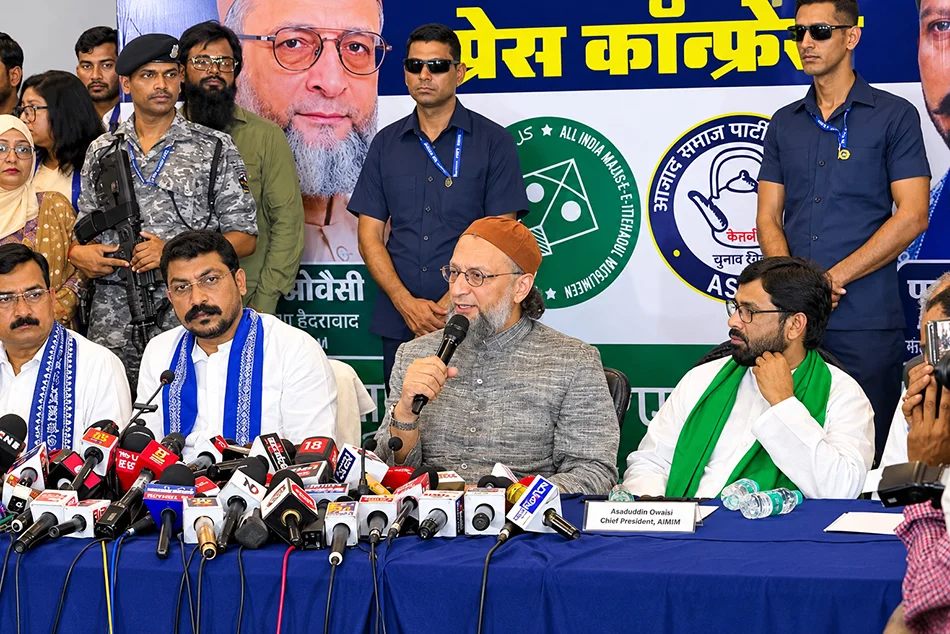
The announcement of the Samajik Parivartan Morcha, an alliance between Asaduddin Owaisi’s All India Majlis-e-Ittehadul Muslimeen (AIMIM) and Chandrashekhar Azad’s Azad Samaj Party (Kanshiram), has added a new dimension to Uttar Pradesh politics.
Announced in Lucknow on November 12, 2026, the alliance named Azad as its chief ministerial candidate and declared its intention to contest all 403 Assembly constituencies. The leaders have presented it as a platform for deprived, oppressed and marginalised communities. They have also invited the Samajwadi Party (SP) and Congress to join them in preventing the BJP from returning to power for a third consecutive term.
On paper, the partnership brings together two recognisable political figures. Owaisi has a national profile and an established appeal among sections of Muslim voters, while Azad has emerged as a prominent Dalit voice, particularly among younger voters.
Yet alliances cannot be judged simply by the communities their leaders represent. Their strength depends on organisation, local leadership, credible candidates, political strategy and the ability to translate social support into votes and legislative representation.
The central question is not whether Dalits and Muslims can come together politically. It is whether this formation can build a meaningful alternative without further fragmenting the opposition vote.
Uttar Pradesh’s Electoral Arithmetic: Why Every Vote Matters
Uttar Pradesh, with 403 Assembly constituencies, remains one of India’s most consequential electoral battlegrounds. The 2022 Assembly results underline the importance of electoral arithmetic. The BJP won 255 seats with approximately 41.3 per cent of the vote. Its allies took the NDA tally to 273. The SP secured 111 seats with around 32.1 per cent, while its allies brought the opposition alliance’s tally to 125. The BSP, once a dominant force in the state, was reduced to a single seat.
The arrival of another formation seeking support among communities that have often voted for opposition parties therefore raises questions about vote distribution. AIMIM and the Azad Samaj Party may argue that they are offering an independent choice. But where their candidates contest against the SP or Congress, the opposition vote could become more divided?
The ‘Vote-Cutter’ Question: Who Benefits From Opposition Fragmentation?
One of the most contentious questions surrounding the alliance is whether it could divide votes that might otherwise consolidate behind the strongest opposition candidate.
The AIMIM has contested elections in Uttar Pradesh but has not built a significant statewide presence. Its influence has been more visible in selected constituencies and in other states. Owaisi’s public visibility, therefore, does not automatically translate into a broad electoral base across Uttar Pradesh.
The concern is particularly relevant in constituencies with a substantial Muslim electorate, where voters may prioritise the candidate they believe has the best chance of defeating the BJP. If an AIMIM candidate contests against an SP nominee in such a seat, even a modest shift in votes could affect the outcome. A similar contest could emerge between Azad Samaj Party, BSP and SP candidates seeking Dalit support.
This is the basis for the criticism that the alliance could indirectly benefit the BJP by splitting anti-BJP votes. However, describing the formation as BJP-backed or as a deliberately engineered vote-cutting operation would require evidence. The alliance’s announcement and available reporting do not establish such a claim.
There is also a democratic counterargument. Voters from marginalised communities cannot be expected to remain permanently tied to the electoral strategies of larger opposition parties. Smaller parties have every right to seek independent political space and offer a different form of representation.
Dalit-Muslim Unity: A Powerful Idea, but is There a Common Programme?
The alliance’s most compelling proposition is the possibility of bringing Dalit and Muslim constituencies onto a common platform. Both communities have faced distinct forms of social, economic and political marginalisation. Their concerns include representation, education, employment, discrimination, social security and access to opportunities.
The Bahujan Samaj Party (BSP) under Kanshi Ram and later Mayawati demonstrated the importance of sustained grassroots organisation, ideological clarity and an independent political identity. Its history also illustrates how difficult it is to maintain a broad social coalition.
This decline has created space for alternative Dalit leadership. Chandrashekhar Azad’s victory from Nagina in the 2024 Lok Sabha elections gave him a parliamentary platform and increased his visibility. But a victory in one constituency does not automatically translate into statewide consolidation.
For the alliance to become a genuine social justice platform, it must offer more than community-based mobilisation. It needs a common programme that recognises the diversity within the constituencies it hopes to represent.
Chandrashekhar Azad’s Statewide Test
Naming Chandrashekhar Azad as the alliance’s chief ministerial candidate is a major political statement. His Nagina victory established him as an elected parliamentarian with an independent base. His politics has appealed to sections of younger Dalit voters seeking leadership that speaks about dignity, constitutional rights and social justice.
That requires district-level organisers, credible candidates and a programme addressing everyday concerns: unemployment, agricultural distress, education, healthcare and social discrimination. Contesting all 403 seats is a formidable undertaking. It requires booth-level networks, financial resources, candidate-selection mechanisms and sustained engagement with voters—not merely public meetings and the visibility of prominent leaders.
Owaisi’s Strategy and the Question of Political Compatibility
For Owaisi, the partnership offers an opportunity to expand AIMIM’s presence in one of India’s most politically important states. The party has an established base in Telangana and has made inroads in selected constituencies in Maharashtra and Bihar, but its performance in Uttar Pradesh has remained limited.
Azad brings a Dalit political profile and a parliamentary mandate that could help the alliance reach beyond AIMIM’s existing support. The partnership, however, raises questions about the distribution of responsibilities and the compatibility of political priorities.
Will AIMIM remain primarily focused on Muslim representation, or will it work towards a broader social justice agenda? How will the partners decide which candidates contest particular seats? What happens if they disagree over political priorities or local alliances?
The alliance must explain how it will coordinate its campaign across regions, resolve disputes and hold representatives accountable. A shared political identity will matter only if voters see consistent priorities, transparent decisions and a credible commitment to constitutional values beyond election season.
The BJP’s Advantage: Polarisation and Opposition Disunity
The BJP’s strength in Uttar Pradesh has rested on organisational capacity, welfare outreach, leadership projection and the ability to build support across caste groups while retaining a substantial upper-caste and non-Yadav OBC base.
A new opposition formation could complicate efforts to create a common platform against it. A divided opposition may make constituency-level contests more favourable to the BJP, particularly where victory margins are narrow. The alliance could also become part of the BJP’s messaging about opposition disunity and identity-based politics. At the same time, it may put additional pressure on the BSP, which has historically sought to build a broad Dalit-centred coalition.
The BJP may benefit from fragmentation, but that possibility should not be treated as proof that the alliance has been created to serve the ruling party. Electoral consequences must be assessed through evidence, not assumption.
The Missing Question: What is the Alternative Agenda?
Beyond personalities and electoral calculations, voters deserve to know what the Samajik Parivartan Morcha proposes to do.
Its leaders have spoken about education, unemployment, farmers and marginalised communities. These are important themes, but they need to be translated into clear policy commitments.
What is the alliance’s plan for generating employment?
How will it improve government schools and public healthcare? What measures will it propose to address atrocities against Dalits, communal discrimination and economic inequality? Where does it stand on agricultural distress, women’s safety and the protection of constitutional institutions?
A credible social justice movement must address the everyday struggles of ordinary citizens. It must connect dignity and representation with access to education, secure livelihoods, quality healthcare, justice and equal opportunity. Without a detailed programme, the alliance risks remaining an electoral arrangement built around the public profiles of its leaders.
Conclusion: Social Justice Must be More Than Electoral Arithmetic
The formation of the Samajik Parivartan Morcha opens a new chapter in Uttar Pradesh politics. Owaisi and Azad are attempting to build a platform around Dalit-Muslim unity and the representation of marginalised communities.
There is nothing undemocratic about smaller parties seeking independent political space. Established opposition parties cannot claim exclusive ownership of the votes of Muslims, Dalits or any other community.
But political freedom also carries responsibility. Leaders, who claim to represent marginalised communities, must consider whether their strategies strengthen their constituents’ bargaining power or inadvertently weaken the collective ability of the opposition to challenge the ruling establishment.
The “vote-cutter” label cannot replace a serious examination of the alliance’s organisation, programme and electoral conduct. Equally, the possibility that the BJP may benefit from opposition fragmentation deserves scrutiny, but it is not proof of a secret understanding between political rivals.
Finally, the Morcha will be judged not by press conferences or slogans but by its ability to build a credible organisation, articulate a shared vision and deliver meaningful representation. Uttar Pradesh needs serious debate on unemployment, education, healthcare, caste discrimination, communal harmony and economic inequality. Its people deserve alternatives that address these concerns rather than treating their identities merely as electoral calculations.
The alliance has announced its arrival. Whether it becomes a meaningful political force or another source of electoral fragmentation will depend on the choices its leaders make before 2027. Social justice cannot remain confined to electoral slogans, and political assertion cannot be reduced to vote-bank arithmetic. The real challenge is to transform representation into empowerment and political ambition into democratic and social change.
[The writer, Mohd Ziyauallah Khan, is a freelance content writer & editor based in Nagpur. He is also an activist and social entrepreneur, co-founder of the group TruthScape, a team of digital activists fighting disinformation on social media.]
Follow ummid.com WhatsApp Channel for all the latest updates.
Select Language to Translate in Urdu, Hindi, Marathi or Arabic