Dirty Secrets about the Indian Judiciary Revealed
There are instances of talking points on the Indian judiciary related to corruption and judgments under pressure, but it is the first time dirty secrets about the judiciary related to sexual harassment has come to limelight, shocking the nation
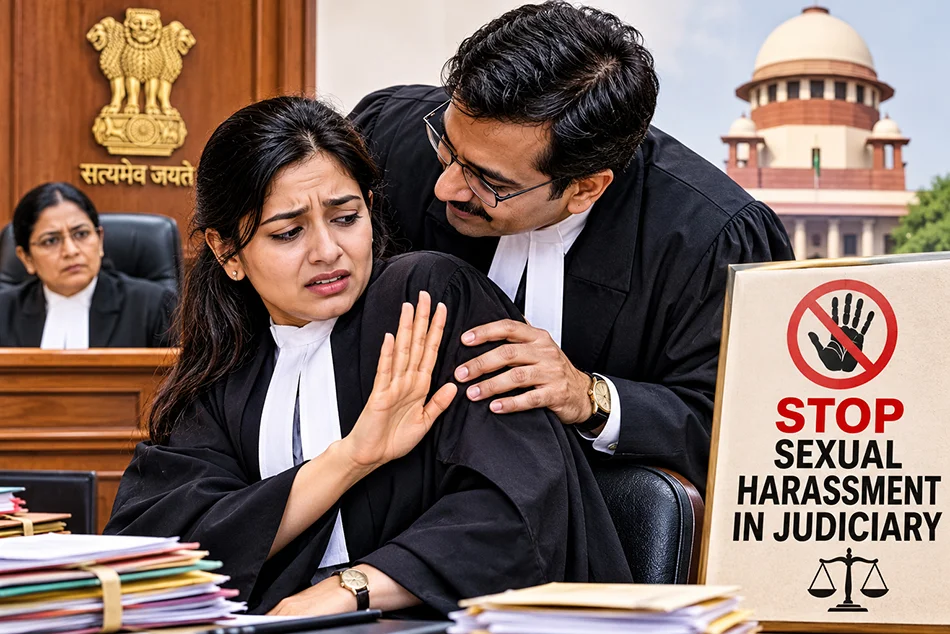
[ChatGPT AI image used here for representation.]
Indian judiciary or its judges are seldom criticized; anyone doing so may be punished. However, there are instances of talking points on Indian judiciary related to corruption and judgments under pressure. But, it is the first time dirty secrets about judiciary has come to limelight, shocking the nation.
Senior Advocate Indira Jaising has raised the curtain over alleged instances of sexual harassment faced by women judges from male judicial colleagues.
Calling it ‘dirty secrets’, the 86-year-old Advocate, has said she had personally encountered several women judges who approached her with complaints of sexual harassment.
Jaising was speaking at the 29th D.S. Borker Memorial Lecture, titled “My Vision of India: 2047 A.D.” on September 01, 2026.
Drawing from her experience of representing women judges, Jaising said that sexual harassment within the judiciary remains an issue that is rarely discussed publicly in India. She said:
“In the course of my experience, I have had to deal with women judges. I have represented a lot of women judges. These women judges have come to me with complaints about sexual harassment by male judges.”
She recounted an incident involving a woman judge whom she had represented in a matter concerning alleged sexual harassment. According to her, a woman judge had described practices in which female judicial officers at the district level were expected to participate in ceremonial arrangements for visiting or retiring High Court judges.
She alleged that women District Court judges were, on certain occasions, expected to line up wearing sarees of the same colour and shower flowers on male judges entering a dining area.
Jaising gave another example of a woman judge’s alleged sexual harassment. She said a male judge allegedly invited a female judge to attend his 25th wedding anniversary celebration. She was then asked to perform an “item number” song in front of the audience. Jaising stated that the woman judge resisted the request, and subsequently, she lost her job.
Jaising criticized such practices, attributing them to hierarchical culture and feudal practices within the judicial system.
High Profile Cases
In India, there are several high-profile cases of allegations of sexual harassment directed at male members of the Indian judiciary.
Chief Justice of India (CJI) Ranjan Gogoi (2019): A former Supreme Court junior assistant accused CJI Ranjan Gogoi of sexual harassment. This included unwanted physical advances at his official residence in October 2018. This was followed by subsequent harassment at the workplace.
An in-house Supreme Court committee comprising Justices S.A. Bobde, N.V. Ramana (who later recused and was replaced by Justice Indu Malhotra), and Indira Banerjee gave a clean chit to Justice Ranjan Gogoi. The committee in May 2019 concluded that there was "no substance" in the allegations.
Justice Swatanter Kumar (2014): A former law intern accused former Supreme Court judge Swatanter Kumar of sexual harassment during her internship in 2011. Justice Kumar strongly denied the claims, filed a defamation suit, and obtained interim relief from the Delhi High Court restraining media reporting on the unverified allegations.
Justice AK Ganguly (2013): Retired Supreme Court Judge AK Ganguly faced allegations of unwelcome behavior and sexual harassment from a law intern in a Delhi hotel room. An in-house committee found prima facie evidence of harassment, though no formal judicial action was taken due to his retirement. The West Bengal Human Rights Commission has raised this issue and called for judicial action against the retired judge.
Complaints involving higher judiciary members are typically handled via internal committee structures, such as in-house inquiry panels. There is Sexual Harassment of Women at Workplace (Prevention, Prohibition and Redressal (POSH Act 2013) that applies to workplaces, including court systems, complaints against judges, staff, lawyers, and litigants.
However, some civil society groups and legal rights advocates are not satisfied with such an innocuous structure. They have repeatedly called for greater transparency, external representation, and independent oversight in such cases.
[The writer, Syed Ali Mujtaba, is a journalist based in Chennai. He can be contacted at syedalimujtaba2007@gmail.com. Views are personal.]
Follow ummid.com WhatsApp Channel for all the latest updates.
Select Language to Translate in Urdu, Hindi, Marathi or Arabic