Modi’s GTA Moment: Propaganda Vs Reality
Instead of focusing on the opportunities this industry offers India, Prime Minister Narendra Modi chose to use the launch of Rockstar Games’ Grand Theft Auto VI (GTA VI) to promote his government’s achievements.
The wait is finally over. Rockstar Games’ Grand Theft Auto VI (GTA VI) arrived on November 19, 2026, after more than thirteen years, marking a major milestone for the global gaming industry. Yet, instead of focusing on the opportunities this industry offers India, Prime Minister Narendra Modi chose to use the occasion to promote his government’s achievements.
The report shared on the microblogging platform X, formerly known as Twitter, appears to be little more than an exercise in exaggeration, with the Prime Minister and his government presenting inflated claims to mislead citizens. In this article, we will examine the gap between the claims made by the Prime Minister in this GTA-themed report and the ground realities surrounding the achievements he highlights.
A Development Report or Political Advertisement?
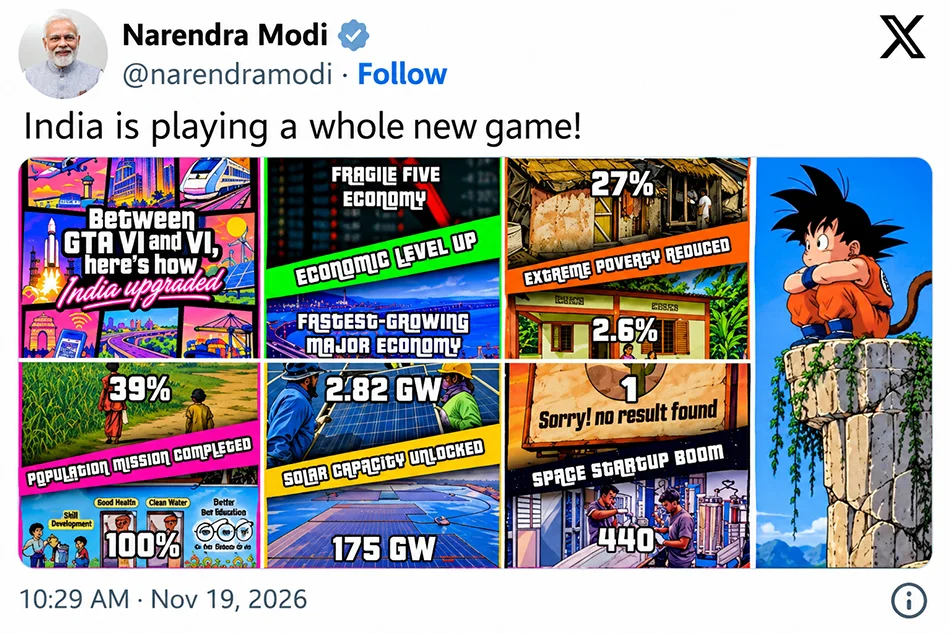
On November 19, Prime Minister Narendra Modi joined the global GTA VI conversation through graphics shared on his official Instagram and X accounts. Using the familiar visual style of the gaming franchise, the post compared India in 2013, when GTA V was released, with India in 2026.
The accompanying message declared: “India is playing a whole new game!”
The graphics showcased achievements across economic growth, poverty reduction, sanitation, railway electrification, solar energy, space technology, digital connectivity, defence exports and internal security. The political message was unmistakable: the UPA years represented stagnation, while the Modi era supposedly transformed India.
There is nothing wrong with a Prime Minister communicating his government’s achievements. Genuine progress deserves recognition. However, there is a difference between presenting development and turning selected statistics into a political victory parade. A closer examination reveals a more complicated picture.
Decoding the GTA Scoreboard: What do the Numbers Actually Tell us?
- From the Fragile Five to the Fastest-growing Major Economy: India’s inclusion in the Fragile Five in 2013 reflected concerns over inflation, currency pressures, capital flows and external vulnerabilities. Since then, India has strengthened several macroeconomic indicators and emerged as one of the fastest-growing major economies.
That is a genuine achievement. But GDP growth alone cannot define development. The real test is whether growth translates into secure employment, rising household incomes, stronger purchasing power, manufacturing expansion and reduced inequality. Millions of households continue to struggle with the rising costs of education, healthcare, housing and everyday essentials.
- Poverty Reduced from 27.1 per cent to 2.6 per cent: Perhaps the most striking claim in the Prime Minister’s graphics concerns poverty reduction. The World Bank’s April 2026 India Development Update reports that extreme poverty declined from 27.1 per cent in 2011–12 to 2.6 per cent in 2023–24, using its revised international poverty threshold of $3 per person per day in 2021 purchasing power parity.
This is significant progress. However, the World Bank revised its international poverty thresholds in June 2025, replacing the earlier $2.15 benchmark based on 2017 purchasing power parity.
More importantly, escaping extreme poverty does not automatically mean achieving economic security. What about families just above the poverty line, those struggling with irregular employment, household debt and rising expenditure? Poverty reduction must ultimately translate into dignity, opportunity and sustainable improvements in living standards.
- Sanitation Coverage: From 39 per cent to 100 per cent: The Swachh Bharat Mission has expanded toilet access and brought sanitation into the national conversation. However, declaring universal coverage is not the same as ensuring functioning sanitation facilities for everyone.
Government reporting indicates that over 96 per cent of villages had attained ODF Plus status by December 2025. Yet toilet construction, actual usage, water availability, maintenance and scientific waste management are different indicators. A government declaration cannot substitute for an independent assessment of whether communities have sustainable access to safe sanitation.
- Railway Electrification: A genuine infrastructure achievement: The government’s claim of increasing railway electrification from around 20 per cent to 99.6 per cent represents substantial progress. The Ministry of Railways reported 99.6 per cent electrification of the broad-gauge network by July 2026.
However, electrification is only one measure of railway performance. Passenger safety, overcrowding, affordability, punctuality, maintenance and infrastructure quality must also be considered. Development cannot be reduced to a single percentage.
- Solar Energy: Impressive expansion, but unfinished business: India’s installed solar capacity expanded from approximately 2.82 GW in 2014 to around 175 GW in October 2026. This is a remarkable achievement, reflecting growing investment in renewable energy.
But installed capacity does not automatically guarantee uninterrupted electricity. Energy storage, transmission infrastructure, grid reliability and affordability remain major challenges. The achievement is real, but the transition to sustainable energy is far from complete.
- Space Startups: From one to 440: India’s space sector has witnessed significant growth following the opening of opportunities for private participation. The Department of Space reported approximately 440 space technology startups registered on the DPIIT Startup India portal by August 2026.
But registration is not commercial success. IN-SPACe had granted 113 authorisations to 52 non-government entities, including 18 startups, for space-related activities. The sustainability, revenue generation, technological capabilities and contribution of these companies matter more than headline registration figures.
- Defence Exports: From ₹686 crore to ₹38,424 crore: India’s defence exports rose from ₹686 crore in 2013–14 to ₹38,424 crore in 2025–26, according to government figures. This reflects expanding domestic manufacturing and India’s growing presence in international markets.
Nevertheless, rising exports should not be confused with complete defence self-reliance. India continues to depend on foreign technology, components and platforms in several strategic areas. Indigenous research, advanced manufacturing and technological independence must remain the real benchmarks.
- Naxalism: Zero affected districts, but what about the underlying conditions? The government has reported that districts categorised as Left-Wing Extremism affected have declined from 182 to zero by March–April 2026. However, 37 districts remain classified as Legacy and Thrust districts, while one is categorised as a District of Concern. The decline is an important security development. But lasting peace also requires attention to tribal rights, land displacement, education, healthcare, livelihoods and local self-governance. Security achievements must go hand in hand with social justice and inclusive development.
The Digital India Paradox: Cheap Data, Expensive Opportunities?
The Prime Minister’s graphics also highlight the dramatic reduction in mobile data costs. TRAI figures show that average revenue realisation per GB of wireless data fell from approximately ₹269 in 2014 to ₹8.97 in 2024–25, declining further to ₹8.02 in 2025–26.
Affordable internet has undoubtedly transformed India’s digital landscape. However, connectivity alone does not guarantee empowerment.
Can a young person from a modest-income family afford a good computer, quality technical education, reliable broadband and industry mentorship? Can an aspiring developer secure funding to build an original game? Can an independent Indian studio compete with international publishers?
These are the questions that should shape India’s digital future. India has a massive gaming audience, but it still needs a stronger ecosystem to convert its talent into globally competitive gaming companies and intellectual property. The country must move beyond being a consumer market and become a creator and exporter of gaming technology.
The GTA Irony: Gaming, Politics and Responsible Access
There is another dimension to this episode. Grand Theft Auto is not an ordinary children’s game. Its content includes intense violence, criminal activity, strong language, sexual content, nudity and references to drugs and alcohol. The Entertainment Software Rating Board (ESRB) has assigned GTA VI a Mature 17+ rating, citing violence, sexual content, nudity, strong language and drug and alcohol use.
This does not mean gaming should be demonised. It can encourage creativity, strategic thinking, problem-solving and technological skills. However, age-appropriate access, parental supervision and excessive screen time deserve serious discussion.
India has millions of young gamers, including children and adolescents. The country needs a meaningful conversation about digital well-being, age ratings and parental controls rather than treating every gaming trend as a publicity opportunity.
The Promotion and Regulation of Online Gaming Act, 2025, addresses online money games and the protection of vulnerable users. However, regulation of online money gaming should not be confused with a comprehensive age-rating framework for commercial console games.
Meanwhile, Rajya Sabha MP Raghav Chadha also joined the GTA VI excitement, sharing a video of himself waiting for the game’s midnight launch. Politicians are entitled to their leisure. The contradiction lies in their enthusiasm for gaming culture while the larger debate about building a responsible and globally competitive gaming ecosystem receives far less attention.
Final Thought: From Players to Game Changers
The bigger lesson from GTA VI is not merely the political comparison between 2013 and 2026, but the enormous economic and creative opportunities India must learn to capture. India has talented programmers, artists, animators and storytellers, alongside an expanding digital market and gaming industry. What it needs is accessible funding, specialised education, research, incubation facilities, intellectual property protection and opportunities for independent studios.
Indian developers already contribute to international gaming projects. However, supplying talent to global companies is different from creating internationally recognised Indian gaming franchises. Young entrepreneurs need an ecosystem that allows them to build studios, develop original intellectual property and compete globally.
Similarly, development must be measured by improvements in people’s lives, not attractive social media graphics. Poverty reduction must improve living standards, electrification must ensure reliable power, sanitation must guarantee dignity, and economic growth must generate employment and purchasing power.
A gaming revolution should mean Indian youngsters are not merely playing games created elsewhere but designing, developing, financing and owning them. India does not need to play a political game with GTA VI. It needs to learn from the creativity, ambition, technology and investment behind it. The real achievement would be an India where the next Grand Theft Auto is conceived, developed and owned by an Indian company. That would be a real game changer.
[The writer, Mohd Ziyauallah Khan, is a freelance content writer & editor based in Nagpur. He is also an activist and social entrepreneur, co-founder of the group TruthScape, a team of digital activists fighting disinformation on social media.]
Follow ummid.com WhatsApp Channel for all the latest updates.
Select Language to Translate in Urdu, Hindi, Marathi or Arabic