Chalo Delhi 2026: India is on the Verge of Political Transformation
The Ramlila Maidan rally in Delhi on November 1, 2026, could well mark an important turning point in India’s political journey and its significance extends far beyond the number of people who gathered or the presence of more than 19 opposition parties on a common platform
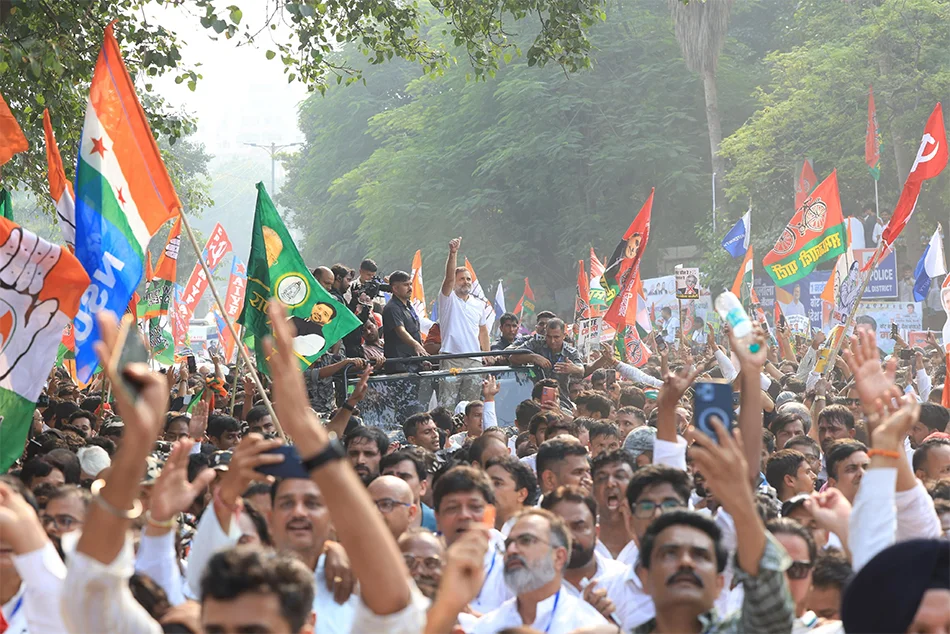
The Ramlila Maidan rally in Delhi on November 1, 2026, could well mark an important turning point in India’s political journey. Its significance extends far beyond the number of people who gathered or the presence of more than 19 opposition parties on a common platform. What unfolded was an unmistakable expression of growing political resentment against the BJP and an increasingly confident assertion that its hold over India’s political landscape can be challenged, confronted and ultimately broken.
For years, Narendra Modi and the BJP have cultivated an image of political invincibility. Their electoral victories, organisational machinery, enormous financial resources and ability to dominate public discourse have been deployed to create the impression that there is no credible alternative to their rule. This manufactured sense of inevitability has been one of the most effective instruments of BJP politics. It has sought to convince citizens that the political future of India has already been decided.
But political dominance is not permanent, especially when it is acquired by duplicitous means and money power that is inexplicable. Beneath the spectacle of electoral victories, public dissatisfaction has been accumulating. Economic insecurity, unemployment, growing inequality, institutional erosion, communal polarisation and the systematic marginalisation of dissent have created a reservoir of resentment. What Ramlila demonstrated was that this resentment is beginning to find a collective political expression.
This was not simply another opposition gathering. It was an assertion that India has not surrendered its democratic imagination to the ideological project of the BJP and its wider Sangh Parivar establishment.
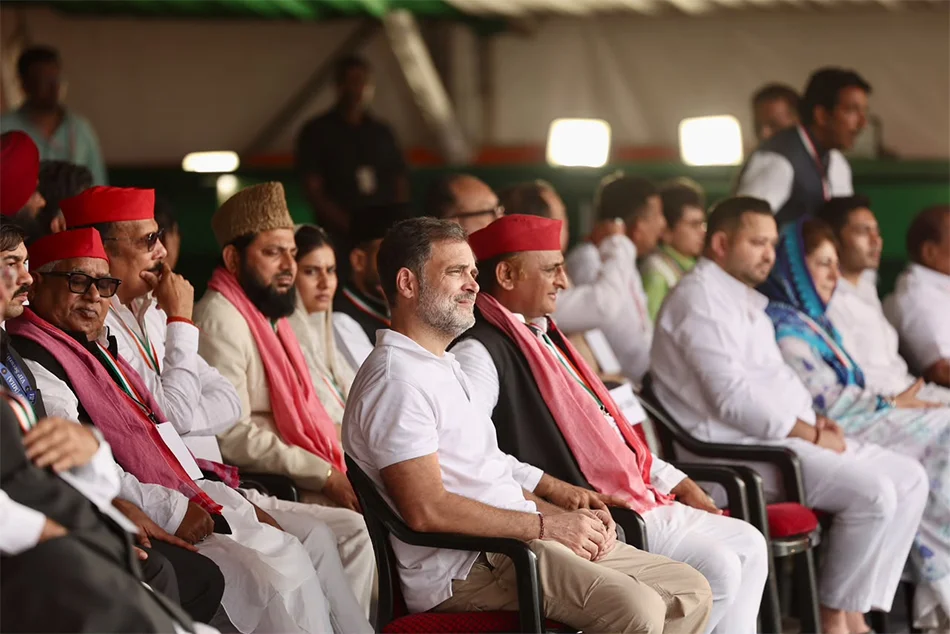
The coming together of Rahul Gandhi, Mallikarjun Kharge, Mamata Banerjee, Akhilesh Yadav, Farooq Abdullah and leaders representing more than 19 opposition parties was politically significant. These parties represent different regions, constituencies and political traditions. Their electoral interests do not always coincide, and their political histories are often marked by rivalry. Yet they recognised that the challenge confronting India is considerably larger than their individual political ambitions.
The INDIA bloc must therefore be understood not merely as an electoral arrangement but as an emerging democratic counterforce. Its importance lies in its capacity to bring together different political constituencies around a common understanding: that the future of India’s constitutional democracy cannot be left to an ideological formation that has increasingly sought to redefine the country through religious majoritarianism.
The BJP would like the country to believe that its political dominance is irreversible. Ramlila challenged that proposition.
The accumulated anger against BJP rule
The political difficulties confronting the BJP cannot be understood through electoral arithmetic alone. They are rooted in a much wider accumulation of public dissatisfaction.
The promise of development and prosperity that once formed an important part of the BJP’s political appeal is increasingly being questioned against the everyday experiences of ordinary Indians. Millions of young people confront an uncertain employment future. Students face anxiety over examination irregularities and recruitment processes. Farmers continue to struggle with economic insecurity, while workers and economically vulnerable families find themselves increasingly exposed to rising costs and diminishing opportunities.
Meanwhile, the concentration of wealth and corporate influence has raised fundamental questions about whose interest’s public policy ultimately serves.
There is a growing contradiction between the government’s presentation of India as an economic success story and the lived experiences of large sections of its population. Political spectacle cannot permanently substitute for economic justice. Nor can religious mobilisation indefinitely displace questions of employment, education, healthcare and social security.
The BJP’s response to public dissatisfaction has too frequently been to intensify ideological mobilisation. The politics of religious polarisation has become an instrument through which economic and governance failures are displaced by manufactured cultural confrontations.
This is not simply a disagreement over political priorities. It represents a deeper ideological confrontation over the kind of country India is meant to be.
The majoritarian politics of the BJP and the Sangh Parivar seeks to subordinate India’s constitutional pluralism to a particular understanding of national identity. It has normalised hostility towards minorities, weakened the space for dissent and encouraged an increasingly intimidating political environment. The consequences are visible in the erosion of social trust and the insecurity experienced by communities that do not fit into the ruling establishment’s preferred ideological framework.
Such politics must be confronted without equivocation. Fascistic tendencies do not become acceptable because they acquire electoral legitimacy. Electoral victories cannot provide a moral licence to undermine constitutional freedoms, intimidate dissenters or divide citizens along religious lines.
India’s democratic inheritance is considerably larger than the political ambitions of any one party or ideological movement.
Electoral democracy cannot become an instrument of political control
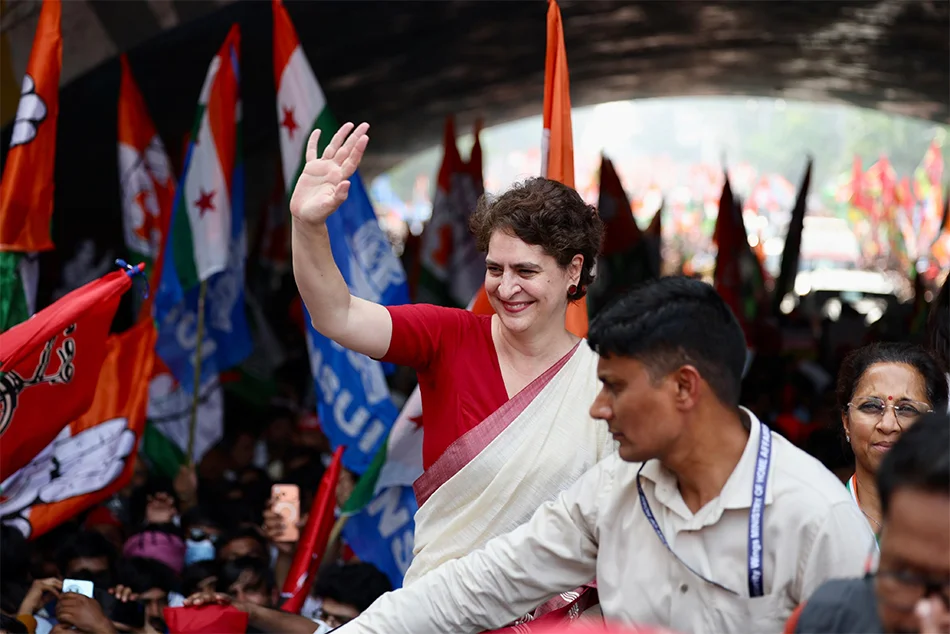
The controversy surrounding the Special Intensive Revision of electoral rolls has given the opposition an important democratic issue around which to mobilise.
The right to vote is not a privilege granted by the government. It is a fundamental component of representative democracy. Every eligible citizen must be able to exercise that right without administrative obstacles, arbitrary exclusions or political interference.
Reports referring to more than 130 million names being removed from draft electoral rolls have generated serious concern. The Election Commission maintains that the removals include deceased, duplicate, absent and permanently shifted voters. The opposition, however, has questioned the possibility of wrongful deletions and the potential disenfranchisement of vulnerable communities.
These concerns cannot simply be dismissed as partisan allegations. They demand transparency, independent scrutiny and accessible mechanisms through which every eligible citizen can establish their right to vote.
The Election Commission occupies a position of extraordinary constitutional importance. Its credibility cannot depend on the political convenience of the government of the day. Public confidence in electoral institutions is essential to the legitimacy of every government elected through them.
The Supreme Court’s scrutiny of aspects of the revision process adds further significance to the debate. Transparency in documentation, accessible procedures for appeals and the restoration of eligible voters must be treated as democratic obligations.
The INDIA bloc is right to make electoral integrity a central political issue. It is defending the principle that the people, and not the machinery of government, must determine who governs India.
The larger concern is the increasing concentration of political power and the weakening of institutions that are expected to function independently of the ruling establishment. The credibility of constitutional bodies, investigative agencies and electoral institutions must be defended. Democracy cannot survive when institutions meant to hold power accountable are perceived as instruments of those who exercise it.
The opposition must pursue this campaign with determination, documenting irregularities, securing legal remedies and ensuring that no eligible citizen is deprived of the vote.
The politics of communal polarisation must be defeated
One of the most disturbing features of contemporary Indian politics has been the systematic use of religious identity as an instrument of political mobilisation. The BJP and the wider Sangh Parivar have repeatedly sought to transform political contests into confrontations between religious communities.
This is not an incidental feature of their politics. It is central to the majoritarian ideological project they seek to advance.
The consequences extend far beyond elections. They affect the social fabric of the country, encourage prejudice, undermine minority security and progressively weaken the idea of equal citizenship. When religious identity becomes the principal measure of political belonging, the constitutional promise of India is placed in jeopardy.
The opposition must refuse to accept the terms of this political discourse. It must not allow every election to become a referendum on religious identity, nor should it permit the ruling establishment to escape accountability by manufacturing communal confrontations.
The INDIA bloc represents an opportunity to reclaim a different understanding of India: plural, secular, democratic and committed to the equal dignity of every citizen.
This is not a defensive political position. It is a positive national vision.
The Indian Constitution does not belong to one religious community, one political party or one ideological formation. It belongs equally to every Indian. The struggle to defend it is therefore not simply an opposition campaign. It is a struggle for the character and future of the Republic.
Rahul Gandhi and the emerging confidence of the opposition
Rahul Gandhi’s evolving political role deserves particular attention. His interventions on constitutional safeguards, electoral transparency, institutional accountability and the concentration of economic power have helped give the opposition a more recognisable national narrative.
His importance lies not simply in being the principal national face of Congress, but in his willingness to challenge the ideological foundations of the present political establishment.
The opposition cannot build a lasting alternative by relying exclusively on anti-incumbency. It must articulate what is fundamentally wrong with the prevailing model of governance and what should replace it. The relationship between constitutional democracy and economic justice must become central to that alternative.
At the same time, the INDIA bloc must recognise that it is much larger than any one party or leader. Mamata Banerjee, Akhilesh Yadav, regional political formations and other alliance partners bring their own constituencies, experience and political strengths. Their contribution is indispensable.
The emergence of a credible national alternative requires political maturity, mutual respect and an understanding that the larger democratic struggle transcends individual ambitions.
The INDIA bloc’s diversity is its strength. It brings together different political traditions that share a common commitment to challenging the authoritarian and majoritarian direction of the country.
The coming together of political resentment and democratic resistance
The Ramlila rally should be understood as part of a larger political awakening. The growing dissatisfaction among young people, students, workers, farmers, minorities and sections of the middle class provides the social foundation for a much wider democratic mobilisation.
These concerns are interconnected. Employment insecurity, economic inequality, the weakening of public institutions, attacks on civil liberties and the politics of religious polarisation are not separate grievances. They are expressions of a political system that increasingly appears unresponsive to the needs of ordinary citizens.
The INDIA bloc has the opportunity to give these concerns a coherent political expression. It must connect constitutional democracy with economic justice, secularism with social harmony, and electoral accountability with the everyday struggles of citizens.
There is no reason to assume that a political movement must emerge outside established political formations to possess popular legitimacy. Political parties can become instruments of wider social movements when they are prepared to listen, organise and act beyond their immediate electoral interests.
Ramlila could provide the beginnings of such a convergence.
The responsibility now is to take this energy beyond Delhi. The INDIA bloc must reach towns, villages, universities, workplaces and communities across the country. It must build a political presence that is continuous rather than episodic, engaging people not merely during election campaigns but throughout the political process.
The alliance must also translate its political unity into practical electoral coordination. Differences over constituencies and regional ambitions cannot be allowed to become obstacles to the larger democratic objective.
India needs an opposition that is confident enough to lead, rather than one that constantly behaves as though it is seeking permission to challenge the ruling establishment.
The BJP’s political decline and the possibilities ahead
The most important question arising from Ramlila is whether the political conditions that once sustained the BJP’s dominance are beginning to change. There are compelling reasons to believe that they are.
The BJP’s politics faces mounting questions about governance, economic priorities, institutional credibility and its reliance on communal polarisation. Its political messaging is increasingly encountering resistance from sections of society that are unwilling to accept the continuing subordination of democratic and economic concerns to ideological mobilisation.
The opposition, meanwhile, is demonstrating a new willingness to challenge the ruling establishment collectively.
The history of Indian politics has repeatedly shown that apparently invincible political formations can lose their hold when public resentment finds an organised expression. The Congress dominance of earlier decades eventually gave way to powerful political realignments. Governments that appeared electorally secure have been defeated when the electorate decided that their time was over.
The BJP is not immune to that political reality.
The experience of the 2019 general election also remains an important subject of democratic scrutiny. Serious questions have been raised over the electoral environment, the use of enormous financial resources, the role of communal polarisation, political intimidation and the influence of institutions. Allegations of electoral malpractice and intimidation must be investigated rather than brushed aside. No election, however decisive its declared outcome, should be beyond public scrutiny.
The democratic opposition must insist that electoral legitimacy rests not merely on declared results but also on the integrity of the entire electoral process.
What is emerging now is a different political atmosphere. The opposition is increasingly prepared to challenge the ideological and institutional foundations of BJP rule. Public dissatisfaction is finding political expression, and the INDIA bloc is beginning to demonstrate the possibilities of a national alternative.
The next phase must be one of sustained mobilisation. The opposition must deepen its grassroots presence, defend constitutional institutions, articulate an economic alternative and make the protection of India’s plural social fabric central to its political programme.
The task is not simply to replace one government with another. It is to restore democratic accountability, rebuild public institutions and reclaim the constitutional promise of an India in which every citizen enjoys equal dignity and rights.
The Ramlila rally was an assertion that India has not surrendered its democratic future to the BJP. It demonstrated that resistance is gathering strength, that political alternatives are possible and that the ruling establishment can be challenged.
The BJP has spent years projecting itself as the permanent political force in India. That projection must now be confronted with the growing reality of public resentment and opposition consolidation.
The question is no longer whether the BJP can be challenged. The question is how quickly the democratic forces of India can turn this growing resistance into a decisive political transformation.
India needs that transformation. Its democracy needs it. And the INDIA bloc has an historic opportunity to lead it.
[The writer, Dr Ranjan Solomon, is an author, researcher, and freelance writer focused on global and national justice. Over a 58-year career beginning at age 19, he has worked closely with oppressed and marginalized groups. A central pillar of his human rights advocacy has been his steadfast solidarity with the Palestinian struggle against occupation and apartheid. A regular commentator on socio-political issues, his articles frequently appear in major digital and print media.]
Follow ummid.com WhatsApp Channel for all the latest updates.
Select Language to Translate in Urdu, Hindi, Marathi or Arabic