Threats to Justice Gautam Patel’s family from "Dawoodi Bohra Guild"
To non-Bohras, the Dawoodi Bohra community, largely consisting of traders and businesspersons, appear to be peaceful, but there are many instances where they have been internally violent and highly intolerant
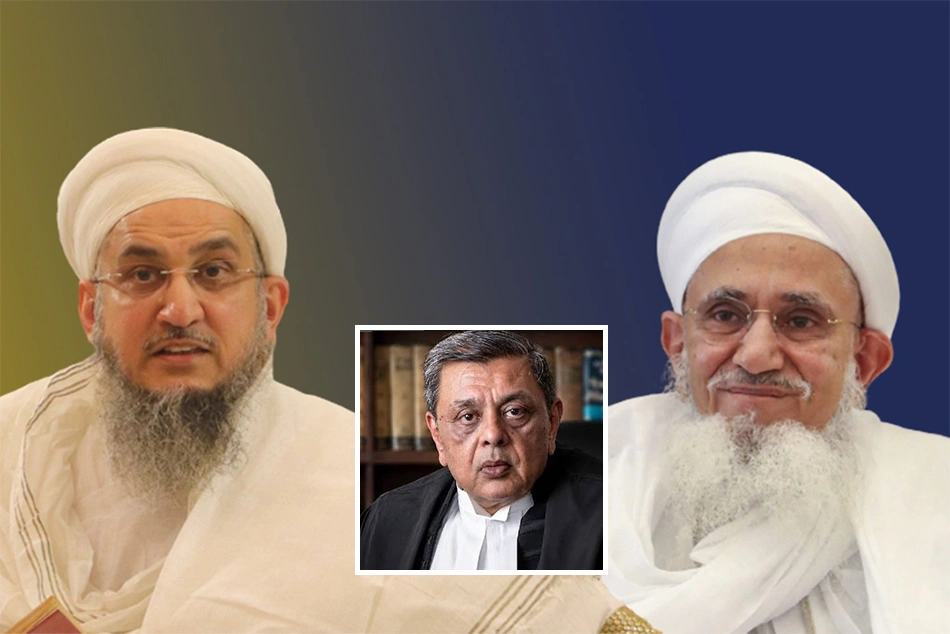
[The decade-long legal battle, popularly known as Dawoodi Bohra succession case, was initiated in 2014 by Syedna Mufaddal Saifuddin's uncle Khuzaima Qutbuddin and continued by his son Taher Fakhruddin after Qutbuddin's death. The Bombay High Court bench of Justice Gautam Patel ruled in favor of Syedna Mufaddal Saifuddin, officially upholding his position as the 53rd Dai al-Mutlaq (spiritual and temporal leader) of the Dawoodi Bohra community.]
At times, facts can be stranger than fiction. Fathom the repeated threats issued over last 10 months, purportedly by a guild of Dawoodi Bohra (DB) community, to a retd. Judge of Bombay High Court – Justice Gautam S. Patel and his wife, and attack on his daughter residing in the U.K.
The threats reportedly relate to the judgement Justice Gautam Patel had delivered on April 23, 2024 deciding the succession battle between two claimants to the post of the 53rd Dai ul-Mutlaq (Head Priest of the Dawoodi Bohra community) in favour of Syedna Mufaddal Saifuddin.
Both the parties to the suit – the plaintiff as well as the defendant – have not only denied their role, but also condemned the threat to the family members and the attack on Justice Patel’s daughter in U.K..
The legal successor of the original plaintiff in the suit of succession – late Syedna Khuzaima Qutbuddin – have filed an appeal against Justice Patel’s judgement before the Division Bench of the Court and the appeal may be taken up for hearing soon.
Only a well armed militant group can threaten the higher judiciary in the hope to get a favourable judicial decision, which is in the rarest of rare cases. Legal remedies are available to the party that loses their case.
Being just about a million strong, the Dawoodi Bohras are a tiny minority community within the Shia community, which in turn is a small minority within the Muslim minority community. The weight of being a doubled down minority community necessitates them to carry on with their way of life and culture without being too assertive. The Pontiff always expresses support towards the ruling political regimes, including towards the present BJP led regime. The Dawoodi Bohras are visible in all political rallies of the Prime Minister. The Pontiff also contributes significantly to the political fund of the ruling party.
The Pontiffs are also known to liberally contribute to the funds of Muslim Personal Law Board (AIMPLB) and Aligarh Muslim University (AMU) to be in the good books of the Sunni sect. They avoid controversies, and therefore, are perceived to be a peaceful community.
The threats purportedly from a guild of DB community and attack on Justice Patel’s family is therefore bizarre. Even otherwise, it is not common for a member of higher judiciary and even his family to be targeted in such a manner for having delivered the judgment.
Moreover, once the judgement is delivered, the judge becomes functus officio, and the only remedy is an appeal, or a review when provided by law. The judge has no power to withdraw, recant or nullify the judgement in any way – not even when he is in office, and even less so after his retirement.
Justice Patel while speaking to the media said that the threats issued were in different jurisdictions – Mumbai, London and West Hertfordshire in the U.K. where his daughter was attacked and her nose bloodied.
The Peaceful Community
To non-Bohras, the Dawoodi Bohra community, largely consisting of traders and businesspersons, appear to be peaceful. However, there are many instances where they have been internally violent and highly intolerant.
My father, Dr. Asghar Ali Engineer, a leader of the reformist section, was brutally attacked five times. The reformists accept the Pontiff and his religious leadership, but demand that laws of the land be respected and Bohras should be allowed to enjoy the freedoms and rights granted by the Constitution of India in secular affairs, e.g. in choosing their livelihood, or in exercising their electoral choice. Reformist Bohras oppose coercive collection of religious levies, demand accounts for the funds collected from the community, and demand to stop the practice of social boycott.
In all, five attempts were made on Asghar Ali Engineer’s life.
- In 1981, a group of fanatic followers of the then Pontiff stabbed Dr. Engineer in Hyderabad.
- In 1983, fifteen fanatical followers of the Syedna pounded and kicked Dr. Engineer in Cairo, Egypt, until he was unconscious. He would have been killed, but for the arrival of the police.
- On February 13, 2001, Dr. Engineer was beaten by a fanatic mob at Mumbai Airport, and his home and office were attacked and totally destroyed.
- In February 1981, I was beaten up by a fanatic Bohra mob when I was attending a reformist conference.
- The Nathwani Commission Report documents numerous such heinous attacks on those who disagreed with the Pontiffs. The call for violence and mobilisation of violent mobs in most cases was given from the mosques.
The root of intolerance and violence lies in the doctrinal faith propounded by the Pontiff. The Pontiff has claimed in the Privy Council in the Chandabai Galla Case that he is God on earth, and accountable to none, except the God above.
According to the Ismaili faith (which includes the Dawoodi Bohra and the Aga Khan followers also known as Khoja community), the religious leader or the Imam is not only the religious head, he is also the temporal head of the community. Members of the community have to follow all the diktats of the Pontiff, even in what is considered as personal affairs of the individuals.
In order to make it possible for the members of the community to follow every diktat, personal charisma of the Pontiff is hyped up through community controlled media in a sustained manner all the time. The Pontiff promises that he will personally ensure that every member of the community will be admitted into heaven. For the community to believe such hyped-up charisma, the Pontiff claims miraculous powers.
On the other hand, the highly organised and efficiently managed religious establishment called kothar, builds grand mosques, and dargahs, where revered saints of the community are buried, in order to mesmerise the community into submission. The religious worship places have five-star facilities for lodging and boarding serving sumptuous meals at a very subsidised rate. They double up as tourist outings as well. All this reduces religion not as a guide for moral and ethical way of life, as it should be, but as an instrument to seek blind following.
Every Bohra on attaining the age of 12 or thereabouts has to give Mithaq, or an oath of allegiance to the Pontiff, where s/he swears that the Pontiff is the owner of his/her body, mind, soul and all his/her wealth and properties; that s/he will declare war on anyone s/he is commanded to declare war on; that s/he will cut-off all relations with anyone s/he is commanded to. The community celebrates this oath of allegiance, a declaration of slavery.
When the faithful followers were commanded to attack Dr. Engineer, they attacked him and his properties. My grandmother was told to cut-off relations with her son and curse him publicly, and she was forced to do so. She cried profusely after that but she needed to socialise with others in the family. No one is supposed to question any orders of the kothar.
Religion is what the Pontiff declares to be so, even in most heinous and violent acts. Nobody dares to defy the Pontiff. The reformists faced the worst consequences, a prize they were willing to pay in order to awaken the community to thinking and moral beings with dignity and to understand and follow Islam.
The battle of succession after the death of the 52nd Dai ul-Mutlaq Syedna Mohammed Burhanuddin brought out the lowest point to which a human being could stoop. The plaintiff in the suit filed in the Bombay High Court was not only the brother of the 52nd Dai, he was also second in command, designated as Mazoon. The defendant, son of the deceased 52nd Dai, moved in quickly and succeeded in consolidating his hold over the religious establishment. The community, which revered the plaintiff as Mazoon, was ordered to now curse him by the other claimant to the post of Dai.
It is not my case that either party to the suit is behind the attack and threats to Justice Patel and his family. Such threats and attacks should be strongly condemned and those behind should be brought to justice. The point is that such charisma seeking blind following is bound to instigate followers to resort to violence.
[The writer, Irfan Engineer, is Director of Centre for Study of Society and Secularism, Mumbai and son of Dr Asghar Ali Engineer who led the Progressive Dawoodi Bohra movement. Views are personal.]
Follow ummid.com WhatsApp Channel for all the latest updates.
Select Language to Translate in Urdu, Hindi, Marathi or Arabic