Dream Roads: A Village Boy’s Arduous Journey in Self-Making
Published by BlueRose One (New Delhi-London) in March 2026, Dream Roads takes you to a memorable journey of a young boy born into a nondescript and distant village Dengatoli of the erstwhile Purnea district (now part of the Kishanganj district), in the State of Bihar in India
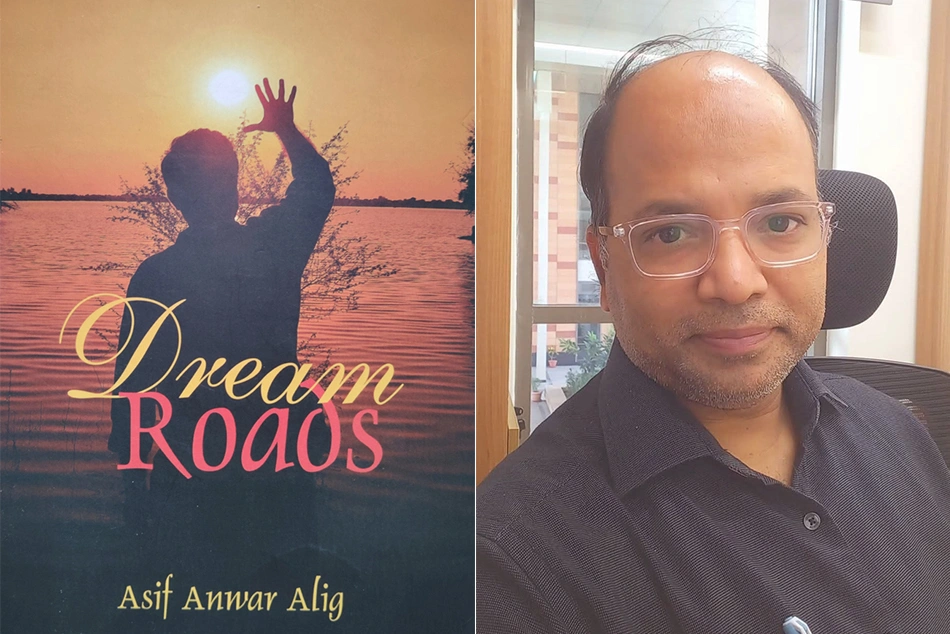
Even after reading a good number of pages of Asif Anwar Alig's memoir Dream Roads, which is also his debut solo work, I got confused about its genre. I thought finishing it would dispel my confusion. However, the confusion stayed even after going through it thoroughly. It is so because Dream Roads cannot be put into any specific category, neithercan the spectrum of its readers be limited to a particular age or taste, because it offers a variety of subjects, each of whose content deserves wholesome appreciation.
Generally, I read a couple of books simultaneously to avoid monotony. And to my happiness, here the author provided me with multiple tastes of reading experience, ranging from local to regional and then from national to international perspectives, each with life lessons of a practitioner of electronic and print media who, at the peak of his media career, joined the job of academic management and then decided to become an entrepreneur.
Published by BlueRose One (New Delhi-London) in March 2026, Dream Roads takes you to a memorable journey of a young boy born into a nondescript and distant village Dengatoli of the erstwhile Purnea district (now part of the Kishanganj district), in the State of Bihar in India, then infested with loot, crime, underdevelopment and the worst kind of illiteracy from where his wings slowly gather strength under the protective grooming of his parents, and with passage of time and equipped with higher literacy in the prestigious Aligarh Muslim University, which he repeatedly reverently refers to as the Oxford of the East that he literally flew over the seas to cross the national boundary, landingquite a challenging yet rewarding job at the Prince Mohammad bin Fahd University, in the Kingdom of Saudi Arabia.
A recurring reference is made throughout the book to the author’s Abbu or father in Urdu, a committed teacher whose role in shaping up his career has been pivotal given the circumstances and situations prevalent in Seemanchal during his formative years as a student of maktaband madrasa in his native village,then at Rauta High School, Purnea, then his senior secondary education in Patna and finally his enrollment and academic life at the Aligarh Muslim University (AMU).
Dream Roads is a treasure-trove of knowledge of Seemanchal's diverse socio-cultural and political history and the problems that this fertile region of Bihar faced during the last quarter of the 20th century and beyond. Some of those challenges have been overcome with individual and collective efforts of a number of people some of whom have been mentioned in the book while the names of many others are either overlooked or left for lack of time and space. However, what makes this debut work of Asif Anwar worth reading is the story of struggle, optimism, patience, perseverance and a can-do attitude towards life and its bounties awaiting those who have the right aptitude and willpower to overcome any obstacle to reach a meaningful place in life and carve a niche for themselves a great takeaway from the book.
Asif Anwar must have met those negative minds and people who hamper success, but he hardly mentions them and provides one of the greatest mantras of success that perfect balance comes only when we accept hardships and rewards with equal prudence. He believes that grooming takes many forms and comes with its own set of challenges as well as blessings, as he eloquently puts it: Countless challenges tested my willpower, forced me to bend, but my firmness taught me to look forward, for the zenith of success lies beyond zeal.
The broader theme apart, the number of topics covered in the 231-page book is amazing; family, friendship, discipline, education, hostel life, culture, cultural dilution, courage, ambition,failure, success, loss, history, identity, language, literature, journalism, media, management, migration, religion and sufism, to name just a few.
Chapter 6 entitled Faith Accompli describing the author’s encounters with sufism adds a different dimension to his life. While on his official assignment of ETV Urdu to cover the annual Urs of Sufi Saint Khwaja Moinuddin Chishti (1141-1236 CE), he felt that the impressive scene at the shrine boasted a towering replica of human sustenance tradition in a communal harmony celebration as devotees of almost all faiths around the world gathered. After his newfound love for sufism which is also reflected in his deep study of this spiritual way of human life, he writes that the Sufi culture significantly expanded religious pluralism alongside secular perspectives.
Though the author's journey from his native place to the state capital, to AMU and to his employment at the national capital and then at a management institution and still moving further to a foreign shore and yet again to an institute of management back in India keeps the reader engaged with the gripping narrative, repetitive use of attributes with some persons, places and institutions could have been avoided to make for a smoother reading, but such reverences are includedto the subjects of the study due to the intrinsic human nature and emotions involved especially those attached to one's teachers, mentors and alma maters. Further, a note on transliteration could have helped avoid confusion about the few Arabic words which do not follow the international pattern.
The book’s language has been kept simple. But one still finds a refined literary taste of language as well as novel sentence formation and piecing together of anecdotes which speaks volumes about the efforts that must have gone into making the book a work of exceptional quality. Coming from a literary genius with over 25 years of experience as a journalist and media specialist in India and in the Kingdom of Saudi Arabia, Dream Roads certainly is a valuable addition to the existing body of literature both on Seemanchal and the national and international media studies and management landscape.
[Manzar Imam, an English and Urdu bilingual Writer, Journalist and Translator, has a Ph.D. in International Studies from Jamia Millia Islamia, New Delhi and has also done the “Contending Modernities” program of the University of Notre Dame, USA.]
Follow ummid.com WhatsApp Channel for all the latest updates.
Select Language to Translate in Urdu, Hindi, Marathi or Arabic