Why Palestinianism Is Misread as Hostility, and Why This Misreading Must End
Palestinianism is a dignity-centered framework grounded in humanitarian practice, yet it is often misread as political hostility
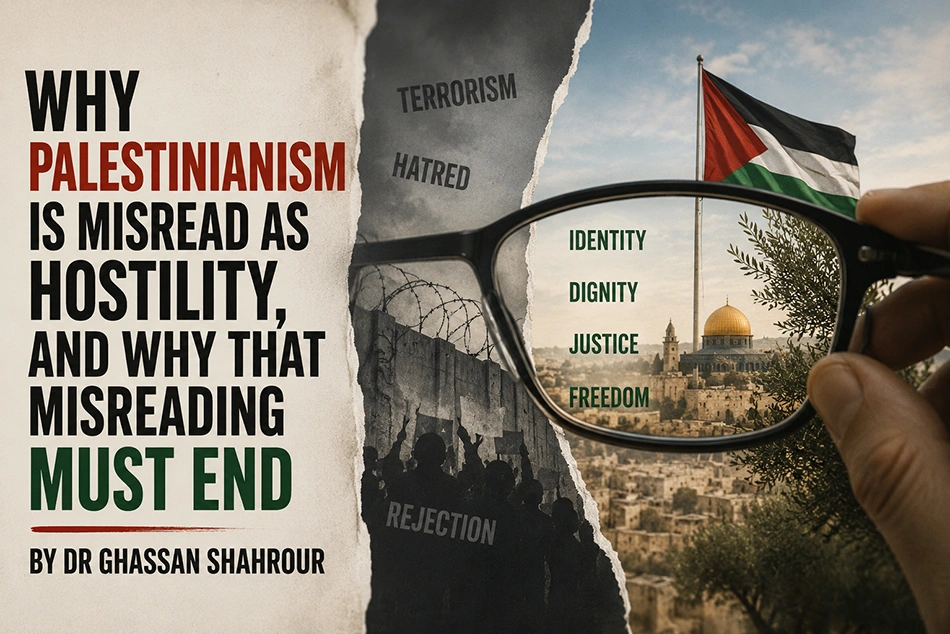
Palestinianism is a dignity-centered framework grounded in humanitarian practice, yet it is often misread as political hostility. This misreading persists even though many Jewish ethical voices, including Dr. Gabor Mate and Professor Richard Falk, affirm that acknowledging Palestinian suffering is an act of universal moral responsibility, not antagonism.
A Framework Misunderstood Before It Is Read
Palestinianism examines how systems of protection operate, why they fail, and how they might become more equitable. It draws from decades of humanitarian experience and from the lived reality of a people who have endured dispossession, erasure, and structural exclusion. Yet any framework that centers Palestinian experience, even when grounded in universal ethics, is quickly accused of bias. This reflex reveals more about entrenched narratives than about the framework itself.
Why Centering Palestinian Experience Triggers Discomfort
The purpose of Palestinianism is not to elevate one people above another. It is to use a prolonged encounter with exclusion to illuminate how protection systems function across contexts. Restoring visibility to Palestinians disrupts long-standing hierarchies of empathy. It challenges the assumption that some suffering is morally urgent while other suffering is explainable or politically inconvenient.
Historian Ilan Pappe has described how the Palestinian story has been “systematically removed from the realm of legitimate history.” When a narrative has been suppressed for decades, its reappearance is often met with resistance. Palestinianism does not create this discomfort; it exposes it.
The Accusation of Antisemitism
One predictable accusation is that Palestinianism is antisemitic. This claim arises not from the content of the framework but from the political sensitivity surrounding any discussion of Palestinian suffering. Palestinianism critiques structures, not identities. It examines systems of exclusion, not communities.
Jewish philosopher Judith Butler has warned that equating criticism of state policies with antisemitism “instrumentalizes Jewish identity to shield power from accountability.” This insight is essential. Confronting injustice is not an act of hostility; it is an ethical obligation.
The Claim of a Hidden Political Agenda
Another common accusation is that Palestinianism carries a hidden political agenda. In reality, Palestinianism is grounded in humanitarian practice, not ideology. It asks why some communities receive immediate global attention while others endure prolonged harm. These questions are not partisan. They are foundational to any serious discussion of human dignity.
The Charge of One-Sidedness
Some will argue that Palestinianism is one-sided. Yet every analytical framework begins with a specific case. The value of Palestinianism lies in its ability to illuminate universal patterns through a particular history. Architect and theorist Eyal Weizman has shown through Forensic Architecture that studying one case of structural violence can reveal global patterns of harm. Specificity is not bias; it is methodology.
Why These Critiques Arise
Critiques of Palestinianism emerge for several reasons.
Structural resistance: Systems resist frameworks that expose their failures. Palestinianism reveals how protection mechanisms can be selectively applied, withheld, or manipulated.
Psychological discomfort: Acknowledging Palestinian suffering challenges deeply rooted narratives and requires moral symmetry.
Political incentives: Some actors benefit from framing Palestinian narratives as dangerous or illegitimate. Accusations become tools of narrative control rather than genuine ethical concerns.
Jewish historian Alon Confino has written that societies often “fear the memories they have suppressed,” because those memories demand accountability. Palestinianism brings suppressed memory into analytical view.
What Palestinianism Actually Offers
Palestinianism offers something constructive: a universal lens for analyzing exclusion and a human-centered ethic that applies to all peoples. It helps identify structural failures in protection systems and offers pathways toward more equitable responses. It is grounded in decades of humanitarian practice and in the lived experience of communities whose dignity has been repeatedly denied.
Jewish physician and trauma expert Dr. Gabor Mate, who lost family members in the Holocaust, has written that acknowledging Palestinian suffering is “an act of human solidarity, not hostility.” His voice is powerful precisely because it emerges from deep historical trauma and moral clarity.
Jewish Ethical Voices Strengthen the Framework
Professor Richard Falk, former UN Special Rapporteur and one of the most respected Jewish public intellectuals of our time, has consistently argued that confronting injustice is a universal ethical duty. He emphasizes that acknowledging Palestinian suffering strengthens, rather than threatens, the global struggle for human dignity. His work shows that Palestinianism stands firmly within a broader tradition of justice, memory, and moral responsibility.
A Contribution to Shared Humanity
Palestinianism will be criticized not because it promotes hostility, but because it restores visibility to a people whose suffering has long been minimized. Its purpose is not to divide, but to illuminate. By grounding itself in universal dignity, Palestinianism becomes a contribution to shared humanity, a framework for understanding how protection systems fail and how they can be transformed.
[Dr. Ghassan Shahrour, Coordinator of the Arab Human Security Network, is a medical doctor, prolific author, and human rights advocate specializing in health, disability, disarmament, and human security. He has contributed to global campaigns for peace, disarmament, and the rights of persons with disabilities, and his work draws on decades of documenting human resilience and dignity in crisis settings.]
Follow ummid.com WhatsApp Channel for all the latest updates.
Select Language to Translate in Urdu, Hindi, Marathi or Arabic