Makkah Defence Pact: Should India be Alarmed?
Diplomatically, at present, it would be wise of India to remain a quiet observer to inking of Mecca Agreement and other developments, it is likely to be least affected by!
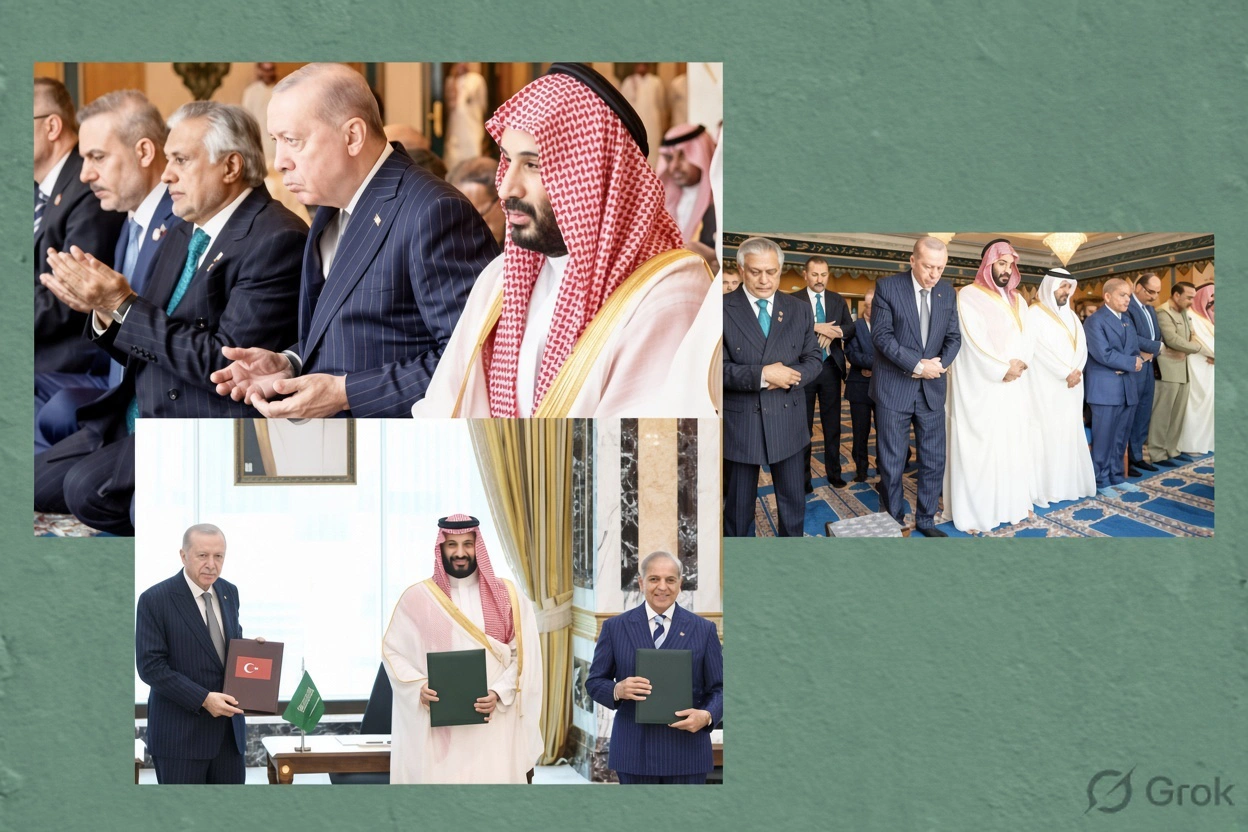
Diplomatically, Saudi Arabia, Turkey and Pakistan have taken a major step by inking the Mecca (Makkah) Joint Defence Agreement. The trilateral pact was signed by Saudi Crown Prince Mohammed bin Salman, Turkish President Recep Tayyip Erdogan and Pakistan’s Prime Minister Shehbaz Sharif on August 07, 2026 in Mecca, Saudi Arabia.
Guided by their historical ties and Islamic solidarity, the three have chosen to share their “strategic interests and long-standing defence cooperation.” The three countries aim to “strengthen their collective security” and promote “peace, security, and stability in the region and beyond,” in “pursuit of a secure and prosperous future.”
Giving the emphasis to “enhancement of all aspects of defence cooperation among the three States,” the Agreement intends to “strengthen collective deterrence against any act of aggression,” and “stipulates that any armed attack against” any one of them “shall be regarded as an attack against them all.” This point is being projected as the most significant of their agreement.
With three key Muslim countries having chosen to pronounce their solidarity at a time, when their region is passing through an extremely fragile phase placing intra-regional as well as inter-regional ties to a crucial test, this agreement certainly raises several key questions. Of which, perhaps the most crucial probably is the key message behind it. If Saudi Arabia was not a part of this agreement, it would not have probably raised so many questions.
The fact that of the three signatories, Saudi Arabia is the most important, diplomatically as well as economically, cannot be dismissed. This also suggests that the agreement would not have been reached if Saudi Arabia did not consider it important, unilaterally as well as regionally and multi-laterally.
The Iranian Angle
Soon after the agreement was signed, the immediate question raised was whether it was targeted at Iran?
United States and Israel would certainly welcome such a possibility. However, US-Israel war against Iran, begun on Feb 28, has failed to drag Saudi Arabia in the trap. There have been a few strikes from Iran against Saudi Arabia, which the former has justified by saying that they were against bases of US in the region. It cannot be ignored, Saudi Arabia send a high level delegation to attend state funeral of Iran’s Supreme Leader Ayatollah Al Khamenei. Diplomatically, whatever may be grievances entertained between Saudi Arabia and Iran, they apparently prefer maintaining ties with each other.
Certainly, Iran-war has provided substantial reason to Saudi Arabia and other countries to enhance their defence. The countries are well aware that Iran is not responsible for initiation as well as continuation of the war and its pauses. Saudi Arabia and other countries have been fairly offended at the war having begun without their being taken into confidence. None of the countries probably expected the war to extend for such a long period and have been stunned by Iran’s capability to face it.
With US security having failed to be of any help to it and with superpower displaying preferential approach towards Israel, Saudi Arabia has chosen give importance to Makkah Agreement. The timing of it being inked draws attention to Saudi Arabia having been probably pushed towards it because of United States’ diplomacy.
It may be recalled, President Donald Trump recently stated that to get a bilateral US-Saudi civil nuclear agreement, Saudi Arabia would have to sign Abraham Accords and normalize ties with Israel. Israel clearly dominates US policy in the region. Saudi Arabia and the other Gulf countries have been long aware of it. However, the Iran-war has cautioned them about risks that same can pose for them. If Iran has been targeted now, it could be another country in the near future. Israel’s plans of emerging as a dominant power and expanding its territorial reach are fairly well known. After Iran, Israel aims to go for Turkey, which is emerging as an obstacle to former’s ambitions in the region. From this angle, Mecca Agreement certainly sends a strong message to US as well as Israel.
Should India be Alarmed?
Just a day before Mecca Agreement was inked, Israel’s Prime Minister Benjamin Netanyahu had a conversation with his Indian counterpart Narendra Modi. They discussed the situation in West Asia and their countries’ strategic partnership. They agreed to remain in touch.
Modi received a call from US Vice President JD Vance this Saturday, a day after Mecca Agreement was signed. They reaffirmed their commitment to strengthen cooperation in trade, defence and other areas. The timing of Vance and Netanyahu’s phone conversations with Modi may be linked with the Mecca Agreement. Perhaps, both US and Israel chose to get in touch with India and reaffirm their strategic commitments with it. This only suggests that the telephone calls rested on their assumption that India was probably alarmed by Mecca Agreement.
Now, the big question is should India be alarmed by it?
India never had friendly relations with Pakistan. At the same time, nuclear diplomacy entertained by two countries cannot be ignored. While their relations are subject to skirmishes, they have not been engaged in any full-scale war since the inking of their nuclear pact. Signed on December 31, 1988, the agreement began being implemented from January 1, 1992, when they exchanged their lists of nuclear installations and facilities. Since then, the lists are exchanged each year on January 1. The agreement prohibits them from attacking each other’s nuclear installations and facilities. Besides, India has good relations with Saudi Arabia. At present, India and Turkey are trying to improve their ties through confidence-building measures.
India, Saudi Arabia Relations
Diplomatically, Saudi Arabia is least likely to take any step that may have a negative impact on its ties with India. Besides, Mecca Agreement is certainly not directed at India. It primarily aims to enhance collective security in the interest of “peace, security and stability” in the region and beyond.
The primary party and the most important country in the Agreement, that is Saudi Arabia, does not view India as a threat and as mentioned entertains good relations with it. India and Turkey are moving towards improving their ties. Certainly, India and Pakistan cannot be viewed as friendly neighbors but the importance the two accord to their nuclear diplomacy cannot be ignored.
Then Why the Deal?
Against the backdrop of US-Israel war against Iran, Mecca Agreement apparently aims to deter any such move in direction of either Saudi Arabia or Turkey. As pointed earlier, Turkey is viewed as new Iran by Israel, that is being projected as its next target. Given the chaos, disturbances and damages caused by the Iran-war, it is possible Mecca Agreement aims to deter consideration of a similar action against its signatories. It is not without reason that the Agreement gives importance to its aim of strengthening “collective deterrence against any act of aggression” and “any armed attack” as either one of them shall be regarded as “attack against them all.”
It is possible, Mecca Agreement prompted Netanyahu and Vance to call Modi. What is important, is that the Mecca Agreement did not lead Modi to move towards giving the two leaders a call. He received the call from Netanyahu on Aug 6 and from Vance on Aug 8. The timing of their calls is partly suggestive of their being concerned about the message carried by Mecca Agreement, even though at present it may have greater symbolic importance than actual.
Israel’s concern is further proved by the sudden timing of Netanyahu rejecting Trump’s Gaza Peace Plan (Aug 9). Considering that Gaza Peace Plan has hardly been implemented, there is nothing surprising about this. Also, it is the timing of Netanyahu's rejection that cannot be ignored. Just when regional and global headlines were being dominated by the Mecca Agreement, Netanyahu’s stand against Gaza Peace Plan surfaced. He has opted for trying to display his dominance by rejecting Gaza Peace Plan. Mecca Agreement has apparently shaken him a little.
Diplomatically, at present, it would be wise of India to remain a quiet observer to inking of Mecca Agreement and other developments, it is likely to be least affected by!
[The writer, Nilofar Suhrawardy, is a Senior Journalist and Writer with specialization in communication studies and nuclear diplomacy. She has come out with several books. These include:– Modi’s Victory, A Lesson for the Congress…? (2019); Arab Spring, Not Just a Mirage! (2019), Image and Substance, Modi’s First Year in Office (2015) and Ayodhya Without the Communal Stamp, In the Name of Indian Secularism (2006).]
Follow ummid.com WhatsApp Channel for all the latest updates.
Select Language to Translate in Urdu, Hindi, Marathi or Arabic