|
 |
|
|
Relations between the ‘Muslim world’
and the ‘West’ have rapidly deteriorated in recent years, and,
despite repeated calls for dialogue, they only seem to be further
worsening. That this bodes ill for everyone—not just Muslims and
Westerners—is too obvious to need any explanation. This book is a
passionate appeal for putting an immediate halt to this rapid
downslide, and to work towards promoting meaningful dialogue between
Muslims and the ‘West’, specifically America.
Nakhleh brings together years of experience, first as a scholar in
residence at America’s Central Intelligence Agency (CIA), and then
as director of the CIA’s Political Islam Strategic Analysis
Programme, as well as insights gained from visits to over 30
Muslim-majority countries to argue the case for a radical revision
of America’s attitude towards the ‘Muslim world’. Put briefly, he
argues that America must rethink several of its current foreign
policies vis-à-vis Islam and Muslims, and that this must go
hand-in-hand with a creative, meaningful, sustained and
multi-pronged public diplomacy initiative directed towards Muslim
publics.
Based on his longstanding role as adviser to senior American policy
makers, Nakhleh remarks that the American government ‘lacks deep
knowledge of the Islamic world and of the diverse ways Muslims
understand their faith, their relations with each other, and their
vision of, and attitudes toward, the non-Muslim world’ [xi]. This,
he suggests, is one of the principal reasons for not just the
failure of most American initiatives in the ‘Muslim world’, but also
for the rapid deterioration in relations between America and the
latter. He laments the marked tendency of many senior American
officials to see the world through the lens of terrorism, to refuse
to recognize that most Muslims do not support terrorism, and to be
unwilling to acknowledge that the majority of Muslims do indeed
support ideas of good governance and are willing to enter into
meaningful dialogue with others, including America.
Nakhleh clearly indicates that Islam, or even what is called
‘political Islam’ or Islamism, is not necessarily a factor for
radicalization or terrorism. He insists that mere increased piety,
or exhibitions of piety and identity assertion, among Muslim publics
must not be seen as a threat or as a prelude to extremism. Yet, at
the same time, he recognizes that ‘an Islamized environment might be
conducive to further radicalization and terrorism’ (p.9),
particularly if the agencies of ‘Islamisation’ are conservative,
literalist Muslim groups, such as, for instance, Wahhabi-oriented
movements. Further, radicalism using the language of Islam must not
be seen simply as an ideological phenomenon. Rather, most often it
is the drastic developments in the external environment that leads
Islamic movements to take to the radical path, such as foreign
occupation, repression by local governments, imperialist invasions
or severe oppression by dominant non-Muslim communities. Nakhleh
clearly recognises that in such cases, radicalism cannot be tackled
through a simple law-and-order or security-driven approach. Without
countering the root causes that lead some Muslims to take to
extremism, such a policy will not just fail but will lead to further
radicalization.
With regard to American policies in the ‘Muslim world’ that have
exacerbated radical Islamist tendencies, Nakhleh identifies
America’s support to dictatorial and repressive client regimes in
Muslim countries, its invasion and occupation of Iraq, its continued
offensives in Afghanistan, and its unstinted support to Israel as
key issues. He insists—and for a retired senior official at the
notorious CIA, this appears strikingly bold and honest—that all this
must stop if American policies are not to continue to lead to the
manufacturing of ever increasing hordes of Muslim radicals. He calls
for the ending of the US-led occupation of Iraq, the scaling down of
American military operations in Afghanistan, an immediate stop to
the torture of Muslim prisoners, serious efforts to solve the
Palestine issue and to end the plight of the Palestinians living
under Israeli occupation, and a just resolution of regional
conflicts in which Muslim groups are involved, as in Kashmir. Mere
sloganeering about democracy, human rights and respect for Islam and
Muslim sentiments will not do, he argues, in the absence of concrete
policy initiatives. He rightly critiques the US establishment for
its tendency to relate to the ‘Muslim world’ mostly or wholly
through the lens of ‘terrorism’, ‘security’, and through the use of
force and threats of forcible regime change. All of this, he writes,
is construed by Muslims as an assault on Islam. It is entirely
contrary to any serious engagement with the ‘Muslim world’ and also
defeats what he regards as America’s ‘national interests’.
Far-reaching changes in US foreign policy vis-à-vis the ‘Muslim
world’, Nakhleh suggests, must go along with well-designed public
diplomacy initiatives directed at Muslim communities globally, in
order to win Muslim hearts. These include a presidential declaration
that reaches out to Muslims, convincing them that America is not at
war with Islam and stressing what Nakhleh regards as common values
and interests of America and the ‘Muslim world’, and various
initiatives to promote ideas of good governance, transparency,
democracy, accountability, fairness, human rights and the rule of
law in Muslim countries. The public diplomacy package should include
initiatives to promote moderation and tolerance, and should involve
Muslim leaders who are committed to the rule of law and gradual and
peaceful change. Efforts must also be made to dialogue and work with
moderate Islamist groups and parties, who, while they may be
critical of certain American policies, support ideas of good
governance and democracy.
Nakhleh suggests some practical initiatives that could be undertaken
by the US to reach out to Muslim publics, including the appointment
of an ambassador to the ‘Muslim world’, initiating dialogue with
‘mainstream’ Islamic parties, developing exchange programmes for
Muslim and Western parliamentarians, students, teachers and
professionals, encouraging American universities to open campuses in
Muslim countries, setting up a national university in America for
the training of imams, empowering Islamic reformers to confront
radicals, expanding American cultural centres in Muslim countries,
and partnering homeland security with local Muslim communities.
Much of what Nakhleh suggests by way of American foreign policy and
public diplomacy measures with regard to the ‘Muslim world’ is
laudable and eminently sensible. But what he fails to engage
seriously with are the very real practical difficulties that some of
these suggestions are bound to face. If America continues to define
its ‘national interests’ (which, Nakhleh writes, would be served by
the policy recommendations he offers) in a very narrow way, will it
at all be willing to promote democracy in Muslim countries,
especially oil-rich ones, where democratically-elected regimes are
likely to stop slavishly toeing American dictates? Given the
enormous clout of the Zionist and Christian Right lobbies in
America, will it seriously be willing to let its much-touted slogans
of democracy and justice guide its policies towards Palestine? Would
America seriously be willing to allow true democracy to flourish in
Muslim lands if this means that Islamist parties might come to power
through the ballot-box? What would their victory mean for democracy
and human rights if the vision of Islam that these groups represent
grossly violates contemporary notions of both? And, taling of
democracy, which Nakhleh passionately calls for with regard to
Muslim states, would America be willing to abandon its role as the
sole super-power and truly allow for a democratic international
order?
The book’s focus is on what America could (or should) do to improve
ties with the ‘Muslim world’. But, what about the other side of the
story? What must Muslims do to improve relations with the non-Muslim
West (and other non-Muslims)? Nakhleh refers to this only in
passing, but it is clear that an urgent task before Muslim reformers
is reformulating new, contextually-relevant understandings of their
religion that accept and celebrate diversity, human rights, gender
justice, and cordial relations with people of other faiths. This
would, of course, mean directly challenging traditionalist,
‘orthodox’, ‘fundamentalist’ and radical interpretations of Islam on
a whole host of issues. Admittedly, that is no easy task, but it is
one that can no longer be avoided.
Despite the obvious limitations of this book, and, in parts, its
tiring repetitiousness, this book simply has to be read by everyone
interested in contemporary global politics and in Muslim issues.
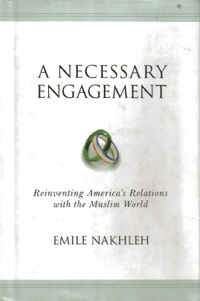
Name of the Book: A
Necessary Engagement—Reinventing America’s Relations With the Muslim
World
Author: Emile A. Nakhleh
Publisher: Princeton University Press, Princeton & Oxford
Year: 2009
Pages: 162
Price:
ISBN: 978-0-691-13525-0
Reviewed by: Yoginder Sikand
Yoginder Sikand
works with the Centre for
the Study of Social
Exclusion at the National Law School, Bangalore
|


 Country of Immigrants, United States is a WORLD in itself
 Book
Review
Book
Review Principal to face
court case over headscarf row
Principal to face
court case over headscarf row British
parliament to have three Muslim women MPs:
British
parliament to have three Muslim women MPs: 
 A street
vendor turned entrepreneur who shared high table with Obama:
A street
vendor turned entrepreneur who shared high table with Obama:  'Indian
Muslims are like twelfth player in a cricket team, always kept as reserve':
'Indian
Muslims are like twelfth player in a cricket team, always kept as reserve':

 Muslim
groups demand fresh probe into Mecca Masjid blast:
Muslim
groups demand fresh probe into Mecca Masjid blast: 

 Comment on this article